The Matthew Effect *

Whatever else the “Occupy” movement accomplishes, it has already popularized the fact–known for a decade to those who pay attention to such things–that the rich in the U.S. are getting richer, while the chasm between them and nearly everyone else is becoming wider, really wider.

The Concise Encyclopedia of Economics notes that “the most careful studies suggest that the top 10 percent of households, with average income of about $200,000, received 42 percent of allpretax money income in the late 1990s.  The top 1 percent of households, averaging $800,000 of income, received 15 percent of all pretax money income.”

Meanwhile, economic mobility–the ‘American dream’–has diminished compared to the promise of increased wealth awaiting our peers in Canada and many Western European countries.  Most jobs now being offered in the U.S. feature lower salaries and wages, fewer if any health benefits, and rarely pensions.

Every pundit has someone or something to blame, as if what this country is experiencing is contrary to nature, an alien blight on our divinely pre-ordained “city on a hill.”  Let the business cycle do its thing, those who have not yet lost their incomes hopefully urge us; let the free market do its thing, aspiring politicians from the right implore us; let research and innovation restore us to prosperity for all, many on the left advise.  But, alas, we are in this pickle precisely because the business cycle, the free market, and technological innovation have been doing their thing.  Whether their destructive consequences are ‘creative’ for the long term, or in a fashion we can accept, remains to be seen.

From the get-go the purpose of technological innovation has been to reduce the cost of production, of which labor is among the largest and least tractable, with or without factories and unions.  Yearly cornucopias of new products to incite consumer spending are at bottom a promise of less work and more play.  Technological innovation today is splendid for innovators, and for entrepreneurs, and for patent attorneys, and for those who package IPO’s.  But it does not create jobs for the multitudes because the technology-driven industrial revolution is behind us.  Adam Smith, who wrote the script for American economic expansion (The Wealth of Nations, 1776), could not have foreseen our post-industrial economy.

Possibly the most powerful natural force leading to a growing chasm between the few rich and a shrinking middle class was recognized two millennia ago by the apostle Matthew, whose ‘day job’ was collecting taxes.  Matthew describes the disparate fortunes of those servants of the Lord who multiply their talents and those who do not: “For unto every one that hath shall be given, and he shall have abundance: but from him that hath not shall be taken away even that which he hath.”[Matthew 28:29]

Two millennia later the sociologist Robert Merton would attribute professional recognition among Nobel laureates to the “Matthew Effect,” a psycho-sociological process having less to do with scientific merit, and more to do with a natural human attraction to success and abhorrence of failure.  The world of sports, where the playing field should be the final arbiter of merit at any given moment, has evolved “winner take all” victories, as if that makes the contest more rewarding to spectators.  And it probably does.

Like the miracle of compound interest, cumulative achievement multiplies the possibilities for greater success.  The rewards for winning early can be enormous over a lifetime, while the human and social costs of early failures may never be overcome.  ‘Winner take all’ triumphs in business (e.g. Microsoft, Google), the advantage of incumbency in our politics and the workings of the US electoral college system, and the cumulative gains from an educational ‘head start’–life is rich with examples of the “Matthew effect” at work.

Whether or not it is a good thing indefinitely for the few to reap rewards vastly out of proportion to their merit and due, while increasing numbers struggle to survive, depends on who is defining the ‘good.’  Sooner or later, however, we will arrive at a tipping point when–as in 1789, 1848 and 1917–defining the ‘good’ will have become an academic exercise.

* (This article first appeared in the Portland Press Herald for January 18, 2012)

Post to Twitter Tweet This Post

Berlin: Then and Now, Part I

On the wall in my writing area is a small black and white photo of two adults dressed in 1940’s era clothes.  The woman wears a dark dress with a large white scalloped collar.  Her head is crowned with a rakish hat.  He wears a double-breasted suit and a fedora.  She smiles proudly.  His serious expression seems about to break into a smile.

Between them, clutching her grandparents’ hands, stands a little girl of about three in a pigtails, squinting at the sun.  To their side standing guard is a chow dog.  His name is Teddy.  Gifted as he was with  a dog’s keen sense of its surroundings, a few years later Teddy will be the one to notify the family,  with a nudge and a whimper, that the grandfather, lying in his sickbed, has died.

The little group is standing on the sidewalk of what is a broad European boulevard, once flanked by elegant houses and shops and busy with pedestrians.  But now this boulevard is virtually barren of other people or vehicles, or anything at all except paving and the unadorned fronts of buildings that stare at the camera with dark, empty spaces where there had been windows.

This is Kurfurstendamm,  Berlin’s Fifth Avenue, in 1947.  When World War II ended for Germany in May of 1945, 75-85% of the city had been destroyed by Allied carpet bombing.   Roughly 40,000 tons of shells fell on Berlin in the last 14 days before surrender on May 7, 1945, a bombardment of civilian targets that gives ‘gratuitous’ a whole new meaning.  Few living then or now would accept that the devastation, German civilian deaths (estimated at 2.5 million, primarily from “collateral fatalities” and the famine of 1945-46) were sufficient penance for the horrors inflicted upon many more millions by the Nazis and their morally obtuse followers.   Some tragedies are beyond the scope of “healing”  or “closure,” the brass coins we toss into the murky waters of our human cruelties.

The grandfather in the photo could remember an earlier time in Berlin at the threshold of World War I.  “Berlin,” wrote Barbara Tuchman in The Proud Tower (1962) was “the natural enemy of Munich and Bavaria.”  Germans from the south thought Berliners cynical and depraved.   The city was either loved or despised as the New York City of central Europe, and for comparable reasons: It was a center of intellectual and cultural life, much of it nourished by Jewish scholars and artists, a crossroads of cultures, and leftist politics.

During the 1920s, before Hitler’s ascent to power, Berlin was the center of a renaissance described by Otto Friedrich in  Before the Deluge (1972). Some of the century’s most gifted figures in the arts and intellectual life–men and women like Sol Hurok, Artur Schnabel, Rudolf Serkin, Yehudi Menuhin and the Zionist and civil rights leader Rabbi Joachim Prinz, who were driven out by the Nazis—remembered the city with affection and sadness.

To see some of the grandfather’s pre-World War I Berlin,  today’s visitor can wander into the Maerkisches  Museum.  This neo-Gothic red brick structure stands beside a quiet garden on the banks of the Spree River.  It resembles a church,  with its huge square red-brick tower startling passersby when it first appears between the trees.   Once inside one might hear the bell, accompanied by the deep rumbling sound of wooden wheels rolling over stone, that announces another step in the gradual rotation of a large circular stereopticon.  Its elaborately carved red mahogany cabinetry nearly fills the room.  At each of the  several individual viewing positions spaced evenly around its sides  a visitor can sit and peer  at 25 successive  ‘3-D’ photographs of the urban bustle and ceremonial traffic of Berlin during its own ‘gilded age’ at the end of the 19th century.  In one image a young man in a homburg hat appears to have stepped suddenly into the foreground as if to speak to the viewer.

Also astonishing in its immediacy is the face of a life-sized wooden figure of the Virgin Mary standing in the museum’s great hall.  She is surrounded by the mute company of other wooden medieval figures.  Her face is unlike most of the other faces one sees on the countless medieval sculptures populating western Europe’s historic places, for this young woman beams an affectionate, this-worldly radiance.  With her relaxed posture, she seems an icon  released into life.  There she stands, balanced at the far edge of medieval Catholicism,  welcoming the coming of Christian humanism and the northern Renaissance.

It in no way disparages the Maerkisches Museum to observe that its medieval religious carvings and delightful stereopticon, capturing for posterity the busy Potsdamer Platz of the first capital of the German Empire (1871-1918), intimate the intellectual prelude to the Third Reich.  They are like a theater’s scrim.  Absent illumination they conceal the ideas which, given the right historical moment, would play out as among the millenium’s greatest tragedies.

For all the intellectual emancipation from early Christian dogma and Papal authority that Europe experienced during the 16th and 17th centuries, and for all the liberalization of intellectual life during the Enlightenment, European Jews were not relieved of their stigma as enemies of Christianity. Driven out of England, France and Germany in the 14th and 15th centuries,  eventual emancipation came to them in much of Europe only in the decades after the French revolution.  Not until after German unification in 1871 did emancipation finally came to Germany’s Jews.  The decades of cultural and economic assimilation that followed came to naught, however.  Germany’s defeat in World War I and fear of Bolshevism after the Russian Revolution provided new pretexts for  a revival of virulent anti-semitism.

Compounding cultural stereotypes that became so perilous for Germany’s Jews was the doctrine of the mystical “state,” a political doctrine that the young man staring back at us at the Maerkisches Museum would have learned at the University of Berlin.  There, students (including American students for whom a German doctorate was de rigueur) learned from the heirs of G.W.F. Hegel that humans are destined by history to strive toward an ideal unity embodied in political form.  There could be no individual identity outside of a historically transcendent cultural, ethnic and political nationality.  The step from this mystical and all encompassing view of human destiny to Aryan exceptionalism and imperialism was short indeed.

But as American pragmatism taught, ideas have consequences, and can be known by them.  The horrendous consequences of Germany’s intoxication with the notion of its Aryan destiny are memorialized in Berlin in an array of  2,700 unmarked concrete plinths of various sizes, set in orderly rows on undulating pavement.  Beneath the assemblage of slabs, which covers the area of a small city block near the Brandenburg Gate, is a small museum with exhibits illustrating the Holocaust.

Although the absence of markings  on the slabs  is deliberate, lest the memorial appear to be a cemetery, some—walking thoughtfully through it—might recall the old Jewish cemetery in Prague.  And others,  very young and less wise and affected, have found it a perfect place to play hide and seek.  Berlin is full of ironies, and this is certainly one:  Survival for millions of European Jews was in fact a most deadly game of hide and seek.

Communities finding themselves alien in a world in which they are “not like us” can be torn, as they struggle for survival, between assimilation and separateness.  It is this which the concrete slabs of Berlin’s Holocaust Memorial, opened in 2005 after much controversy, seem to represent most of all.  Architecturally it is utterly out of place among the more conventionally modern or rebuilt Wilhelmine structures that surround it.   At the same time the rows of similar (though not identical) slabs are nameless, faceless, characterless.

Also architecturally out of place is Berlin’s Jewish Museum, but its dramatic design is far more eloquent.  The building tells its own tale of discontinuities in its dramatic zig-zag outlines—a feature that is retained in the shapes of its windows and  interior spaces.   Its underground corridors, sudden voids,  irregularly shaped rooms,  and Garden of Exile with tilted stelae blanketed in vines and olive trees are the perfect architectural setting for the story the building tells.  In its exhibits visitors can see and contemplate the shards of the history of a remarkable people, a story of life and loss, again and again.  Daniel Libeskind’s extraordinary building shares nothing with the Maerkisches Museum—except its foundations.

(Please continue to Berlin, Then and Now:  Part II)

Post to Twitter Tweet This Post

Berlin, Then and Now: Part II

The tourist buses that unload passengers at the Pergamon Museum and Check Point Charlie rarely stop at the Maerkisches Ufer (quay) of the Spree Canal.  Here reign peace and quiet accompanied by the gentle slip slap of water on the sides of old river barges.  Showing their age, a few barges have been turned by enterprising owners into  small ‘museums.’  Along the ufer a pair of restored neo-classical urban villas bears further witness to the bustling prosperity captured in the stereoscopic images at the Maerkisches Museum.

If one has only one day of beautiful weather to spend in this city, spend it on one of the low-slung passenger boats that chug along  the city’s canals and  encircling Spree and Havel rivers.  For six centuries these waterways, spanned today by hundreds of bridges, were Berlin’s  veins and arteries.  There may be no finer way to glimpse the vagaries of Berlin’s history since its beginnings in the  13th century as a trading center on the north bank of the Spree River.

A boat cruise around the city offers a slowly moving window onto its many neighborhoods–residential, governmental, commercial, rich and poor.  Here, the overflowing trees, shrubs, and flowers of a neglected garden at the back of a villa.  There, the dreary walls of a factory and workers’ housing.   But suddenly, as your boat chugs past the Mendelssohn-Bartholdy park and passes under the Schoeneberger bridge, there in front of you suspended in mid-air from a crane over the German Museum of Technology, is a Douglas C-47 military cargo plane (DC-3 in civilian usage).  The twin-engine aircraft initiated the flights—one every three minutes—of the British and American life line to Berlin after the Soviet Union,  whose post-war zone of occupation included the city, closed off land access on June 24, 1948.

Almost overnight the western allies’ strategic objective of utterly destroying Germany was turned on its head.  Resisting that other horrific would-be hegemon of the mid-twentieth century, the Soviet Union (1922-1991) under Stalin, upturned U.S. military and diplomatic planning.   Berlin would become a beacon of freedom in the long gray twilight that settled over Eurasia during the Cold War.

Where only a few years before aircraft overhead released a fiery apocalypse, now western allied aircraft alone would supply the food, coal and kerosene the city’s people needed merely to stay alive.   This time  modern technology played the essential role in sustaining life,  instead of raining death and destruction.  It cannot be said of all things, “this too, shall pass.”  But it could have been said of the Gӧtterdӓmmerung that occurred over Berlin at the end of World War II.

Berliners called them “rosinenbombers,” or raisin bombers.   Along with Great Britain’s RAF Handley Page Hastings transport aircraft, the US Air Force’s Douglas C-54 (successor to the C-47) ferried well over 5,000 tons  daily of food and fuel into Berlin from June 24, 1948 until September, 1949.  (Though the Soviets abandoned their unsuccessful blockade in May, the western allies continued to build up supplies in the beleaguered city.)  In all kinds of weather heavily loaded cargo planes flew back and forth through three 20-mile wide air corridors between British and American bases in their respective zones of occupation and two hastily repaired air fields in western Allied-occupied sectors of Berlin.

Romance confers the greatest heroism on the pilots and their aircraft.  But the truly miraculous was achieved by the mostly anonymous magicians of logistics. The organization and improvised equipment necessary to load, take-off, pilot, land, unload, and service over 275,000 flights at the rate of one every three minutes was unprecedented. Wal-Mart, FedEx and United Parcel today would be unable to function without the electronic data exchange systems developed during the Berlin airlift to ensure that every bundle of coal and package of dry milk, flour, sugar, pasta, coffee, chocolates and (of course) raisins was collected, inventoried, assigned, loaded, dispatched, flown, unloaded, warehoused and delivered as intended.

On an autumn day one can walk down Clayallee, once the busy central thoroughfare of the American sector in Berlin, virtually alone.  The avenue is named for General Lucius D. Clay, military governor of the American sector of Berlin and, with President Harry S. Truman, responsible for what was a perilous challenge to the Soviet Union in the early hours of the Cold War.  Only an occasional bicycle, tradesman’s van, or private car disturbs the quiet of what is now an affluent residential neighborhood.

Walking from the nearest U-bahn station to the former Outpost theater where GI’s gathered—and which is now the Allied Museum—one might almost miss the somewhat overgrown marble block engraved with Truman’s name, indicating an abandoned park and playing field.  A few steps further the calm of this place is interrupted by the sight of four horses, frozen in bronze, leaping over chunks of a broken wall.  This monument to the collapse of the Berlin Wall in 1989 marks the second time for this city that the political acumen of a few, and the patient persistence of millions, overcame on an historic scale the powerful forces of a malign autocracy.

At the entrance to the Allied Museum stands one of the RAF’s Hastings aircraft.  Compared with today’s regional aircraft, it seems small, though its burden multiplied thousands of times was huge.  The museum itself is dimly lit and lovingly tended.  Hordes of tourists throng the “Checkpoint Charlie” guard house on Friedrichstrasse to have their photos taken with latter day ‘guards’ and buy tchotchkes in the shops that flank that historic street.  But to see the weather-worn original guard house one must find the Allied Museum.  Photographs, old letters and diaries, newsreels, recordings, historical timelines–all attempt to retain, for a moment, an ever receding vanishing point in our historical mindscape.

Thanks to the timeless and universal language of music, one needs no memory at all to treasure still one of the glories of Berlin, the Berlin Philharmonic, founded in 1882.  Nearly bankrupt in 1933, the orchestra managed to survive under Wilhelm Furtwängler only by performing music—Beethoven, Bruckner, and Wagner, among others—that Hitler considered emblematic of German genius and power.

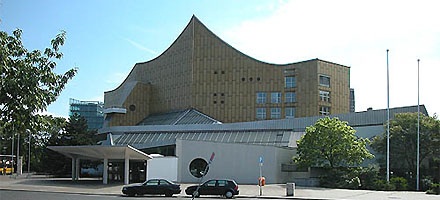
Today the Berlin Philharmonic appears on every list of the world’s top orchestras.  It also performs in a building—the term seems inadequate for the extraordinary architectural composition of spatial sections that is its home concert hall—whose pentagonal interior offers excellent acoustics for virtually every seat in the house.  The 1956 Hans Sharoun design manifests another benign aspect of Germany’s recent history:  The outward appearance of the “Berlin Phil’s” own performance space has been liberated from any compulsion to perpetuate the grand architectural style of Wilhelmine Germany.

Also liberated is the orchestra’s programming.  A recent performance paired Alban Berg’s  only violin concerto with Shostakovich’s 8th symphony. Conducted by guest conductor Andris Nelsons, a Latvian, with his countrywoman Baiba Skride playing the Berg on the Stradivarius “Wilhelmj” violin, the performances earned conductor and soloist a long roar of clapping and shouts of praise that lasted until the performers had long gone and the stage lights had been extinguished. But that is what we have now come to expect, once again, from the Berlin Philharmonic.

When she was eleven the little girl from the photograph  made the first  of several return trips to Berlin from the United States, where she  was taken in the early weeks of the airlift.  Piles of rubble still lay here and there interspersed with dreary, hastily built, apartment blocks with shops on their first floors.  Streets were still fairly empty of private cars, as taxis, buses, and bicycles did the job of moving Berliners about.

Coming from a country where bicycles were then used mostly by children, she might have been forgiven during her visit for walking down a specially constructed and marked bicycle lane.  But a policeman strode up to her and, in a harsh voice, berated her for obstructing the bicycle lane.  From the high peak of his German officer’s service hat to the stiffness of his posture and the black shine of his boots, here was a terrifying reminder of an officially vanquished past.

Today Berlin’s streets are as busy as any other European capital’s, but Berliners still make good use of their wonderful bus, streetcar, and subway system.  On concert nights the city sends out extra buses to transport thousands of music lovers to their shrine, and to collect them afterwards to take them to wherever they might want to go.  Nor is the bus a poor man’s transportation.  Women and men in their best finery press themselves into the buses (queuing is not a German trait), and send up their own chorus of loudly voiced opinions about the concert.  Only the elegant Japanese ladies, dressed in traditional coiffure, kimonos, obis and geta, huddle together on the sidewalk as long black Mercedes limousines arrive to collect them.

Of course, after the concert one wants to be sure to wait at the right bus stop.  That same autumn day, before she goes into the hall to hear Berg and Shostakovich, another policeman approaches the little girl—only she is now over a half–century older.  This time he seems so young, wearing a loose fitting wind-breaker and ordinary brown leather street shoes.  A single side-arm is almost invisible at his hip. The stiffener is gone from his service hat.  Again, he speaks first:  “Excuse me, m’am; I forgot my watch.  Could you please tell me the time?”  Age emboldens many of us.  “Well,” she replies, “I’ll tell you the time, if you tell me where the 110 bus to Kurfurstendamm stops.”  He tells her; and she tell him that it’s 7:30.  He thanks her pleasantly, and she continues on her way.

~~~


Post to Twitter Tweet This Post

Shadowboxing

Political rhetoric thrives on fiction, so it should not surprise us that conservatives’ campaign to discredit progressivism–now in full flame during this mid-term election year–brandishes entirely illusory notions of “free market capitalism,” and its supposed enemy, the federal government.  It is a campaign that engages politicians, the media, and citizens who prefer vaporous illusions to grubby truths in a variety of shadow boxing that has distinguished American politics at least since the New Deal.

The coupling of ‘free market capitalism’ with public sector minimalism is one of the great fallacies of today’s debates over what to do to revive the nation’s economy.  Neither Adam Smith, architect of the free market economy in his Wealth of Nations (1776), nor his followers Richard Morris and Alexander Hamilton among this country’s ‘founding fathers’, argued that thriving ‘private sector’ commerce and strong government were mutually opposed.

Smith knew that we could not count on individuals scrambling for profits to grace us with the public goods that make profitable commercial enterprises possible.  Morris and Hamilton understood that a strong, centralized government was essential to the nation’s economic credibility in a world that–even then–was oiled by international finance.  And they understood that only a strong government could create and maintain the “veins of commerce” that give life to a national marketplace.

To appreciate the virtually sacred status of ‘the private sector’ for many Americans one has to recognize that private wealth has become for enterprising and hard working individuals what salvation once was to the pius: the reward for individual striving.  The sociologist Max Weber detected the affinity between individual salvation and private wealth in largely Protestant societies over a century ago.  A quasi-religious veneration of individual striving acquired its power to shape American politics from the near universal acceptance of social darwinism, seemingly verified by our successful expansion across the continent, and our rise to global hegemony in the 20th century.

Social darwinism (‘survival of the fittest’)–a social philosophy more accurately credited to Herbert Spencer–seeks to justify individual striving as necessary to the evolution of the species toward ever ‘higher’ forms (whatever they might be).  A more perfect example of the distortion of a scientific theory to serve a cultural bias can hardly be imagined.

Do individuals survive because they are more fit?  What is it to be ‘fit?’  If ‘fitness’ is adaptation to an environment, is ‘fitness’ necessarily strength, or greater intelligence?  For biological darwinists certain individuals prevail because of random and heritable genetic variations which enable them–again, randomly–to survive whatever environment happens to surround them. ‘Nature’ does not act on informed judgment, selecting survivors because they are stronger, smarter, or otherwise more ‘fit.’

Moreover, social darwinism leads its believers astray by promoting the notion that individual attributes suffice to account for success or failure.  To the contrary, the success or failure of individuals in  life  (not to be confused with football or beauty competitions) can be due to a host of variables having little to do with their efforts or personal qualities.

Horatio Alger’s Ragged Dick (1868) and Ayn Rand’s John Galt of Atlas Shrugged (1957) are wishful fictions.  As heroic cartoons they fail to reflect the numerous interacting variables that shape what we become, among them:  genetic endowment, our material and cultural environment, resources generated by others, and accidents of time and place.

It may be true that a ‘free market’ driven by the profit motive is most likely to call forth the most efficient use of our talents and energies.  But it is not a guarantee of individual or aggregate national wealth of any description, including GDP.   Nor does the GDP measure national well-being, which is better measured by the H.D. I. (the human development index)  which considers such indicators as education, health and life-expectancy along with GDP.

In the history of this country individual striving has been assisted mightily by three advantages:  the cornucopia of natural resources found in the continental United States, waves of immigration and internal migration, and the system of government–with its intellectual foundations set in the values of the 18th century enlightenment and classical republicanism–crafted during a hot summer in Philadelphia in 1787.

This government, which has survived challenges as great as any we observe today, during the 19th century blazed, charted, dredged, surveyed and cleared land and water routes for the national expansion of private commerce; awarded over 130 million acres of public domain to the railroads for rights of way and as security for bond issues; built the Panama Canal; funded over 70% of the airports and expansion of a national air transportation network during the early 20th century; built the interstate highway system; and fulfilled the country’s penchant for exploration with human and robotic journeys from the Moon to the outer reaches or our universe.

The federal government continues to fight wars not only against military adversaries, but against disease and destitution.  Had we left it up to the profit-motive driven private sector to provide  a critical national infrastructure, we’d still be hitching our oxen up to wagons to haul our goods to market.

In 2005 taxpayers from over half of these United States received back from the federal government more dollars in grants and contracts than they paid in federal taxes.  These states include the home states of Sarah Palin, Senators Jim DeMint, Lindsay Graham, Chuck Grassley, James Inhofe, John McCain, and Mitch McConnell, and Representative John Boehner, among numerous other Republicans in congress or eager to get there.

In fact, about 90% of the federal government’s estimated outlays for 2010 will be returned to private sector employers in the form of grants and contracts positioned in every congressional jurisdiction throughout the land. The ‘iron triangle’ binding the interests of members of congress, the executive branch, and private industry is one of the most powerful determinants of who gets what in the U.S. economy.

Our ‘free market’ has no better friend than the federal government, while our inner cities, with all their community organizers, are no match for US businesses in feeding at the public trough.   Shadowboxing may, alas, garner conservative candidates some votes, but it will not prepare them for the genuine issues that await them in Washington.

~~~~~~~~~~~~~~~~~~~~~~~~~~~~~~~~~~~~~~~

Text sources: Available on request.

Post to Twitter Tweet This Post

Let Us Eat Cake

Poor Marie Antoinette, Queen of France.  ‘You Tube’ has no video of her saying it, so we can’t be sure whether she ever did say “let them eat cake” (or “brioche,” for you purists). Marie was responding to the news on the eve of the French revolution that the people had no bread.  She ate neither bread nor cake after 1793, when hungry and angry Parisian citizens relieved her of her head.  And yet, for all that we do know, the comment was in character–not only for Marie, but for her time.

Fortunately television news  was on hand to confirm that the successful primary election candidate for a U.S. Senate seat from Nevada, Sharron Angle, did declare with comparable indifference that congress should abolish Medicare and Social Security.  (One assumes Ms. Angle and like-minded friends will virtuously forgo the benefits of both.)  When we are old and sick we can eat cake.  Ms. Angle wants us to concentrate instead on our domestic “enemies…who pass these kinds of policies–Obama-care, cap and trade, stimulus, bailouts–they’re certainly not friends to the free market system, they’re not friends.”  Glenn Beck, for his part, includes that nemesis of the free market system, “collectivism,” in the litany of evils he ascribes to Barack Obama’s “belief structure.”

That sacred totem called the ‘free market’ now supports a large tent under which the devotees of Rush Limbaugh, Glenn Beck, and Sarah Palin struggle to override hard conversations about the three most powerful forces that shape American politics: race, region, and class.  The dead give-away is the haste with which their acolytes denounce the “race card” or “class warfare” whenever our current president’s racial heritage, or programs to provide for the greater good, intrude overtly into what passes for political discourse today.

The regions that threaten them are both cultural and geographic: Urbanized regions of the northeast and west coast, inhabited by high-end universities and the “intellectual elites” they produce, people who think it’s important to know what you’re talking about.  A lot of these people, whom they regard as alien to “middle America,” don’t even look and sound like real Americans: Jews, African Americans, Muslims, Latinos, people speaking foreign tongues and practicing strange religions, and of course the New York Times.

If, out of a total U.S. population of 322.3 million, we removed 45.4 million Hispanics or Latinos, 36.3 Blacks or African Americans, and the jumble of  41.1 million of other yellow, red, and brown skinned people, that would leave only 62 percent of the U.S. population who might qualify as “real Americans.” Screen out innumerable homosexuals, 5.7 million Jews, 4.7 million Muslims and readers of the New York Times, and the percentage of ‘real’ Americans gets even smaller.

The Limbaugh-Beck-Palin crowd knows that their views–especially of the nation’s first black president–go against the broad, inclusive grain in contemporary American life, so they masquerade their phobias behind a passion for preserving the ‘free market’ against a supposedly predatory ‘government’ (the same government which, as it serves the Constitution, has allowed the land to become cluttered with all those alien people and their un-American ideas).  After all, who can oppose FREEDOM? Unfortunately, the free market system cannot support the big tent and shelter all the dark fears collected underneath.

One reason is that the architect of the ‘free market’ political economy, Adam Smith, in his The Wealth of Nations (1776) did not view government as a domestic enemy.  To replace an economic model designed to enrich monarchs and their tax collectors (mercantilism), Smith proposed an open economic system of free markets to allocate capital and labor more efficiently (hence, productively), thanks to the market’s automatic regulation of supply and demand.  Like an ‘invisible hand’ it would ensure that capital and labor be turned to their most productive uses, and thus wealth would grow throughout the land.

But Smith was essentially a moralist whose economic views emerged from his moral philosophy.   His Theory of Moral Sentiments (1759) became as popular in its time as Wealth of Nations.  What separated humans from animals, Smith taught, was their inborn capacity for moral judgment and conduct.  This capacity was the source of their naturally occurring moral “sentiments,” which included a preference for the benevolence and justice essential to a moral society.

Smith understood that as the multitudes scramble for profits, they could not be relied on to secure society against the “violence and invasion” of enemies, or to ensure justice, or to carry out the public “duty of erecting and maintaining certain public works and certain public institutions which it can never be in the interest of any individual, or small number of individuals, to erect and maintain.” These things must be done by government.  Adam Smith’s wealthy nation is one in which the opportunity for private wealth does not trump the public good.

Smith, very much a creature of the 18th century, could not have foreseen that his prescription for achieving national wealth would lead to an economic system “red in tooth and claw.”  The Gilded Ages of post-Civil War and post-Reagan America sought to rationalize selfish greed as the competitive energy necessary to create the “richest nation in the world.” What we sowed, we now reap. This nation today finds itself in the midst of an economic crisis of historic proportions, one that is unlikely to end any time soon, while economists and politicians fill op-ed pages and TV screens with prescriptions for cures that shrink from questioning the free market model itself.  Were they to do so, they would be denounced as “communists!”  “socialists!”–or, horrible to contemplate–people who want America to be like Europe!!

Through much of American history the abundance of natural resources and expansion across a vast continent allowed us to believe in our epoch as a time of endless opportunity. Recessions and economic depressions, with their unemployment, lost homes, and millions tumbling backward into poverty, would be mere temporary lags in the economy’s readjustments to the ‘free market’ driven business cycle.

We were, and are, wrong.  Today nearly 15 million people are out of work, a number equivalent to the entire population of the United States in 1835–or to the combined populations of the New York City, Los Angeles, and Chicago, or the combined populations of Alaska, Arizona, Nevada and Utah.  One out of seven Americans has fallen into the slippery sloped depths of poverty, and more are likely to join them in the days ahead. Compounding this widespread failure of our economy to increase national wealth is the failure of the ‘invisible hand’ of the market to distribute what wealth we do generate throughout society to a degree that will be politically sustainable for long.

The disparity in pre-tax incomes between the rich and everyone else is now greater than at any time since the 1920’s.  Of incomes reported on tax-returns, 15 percent of all pre-tax income went to 1 percent of households, with average annual incomes of roughly $800,000.  The top 10 percent of households now receives over 40 percent of total pre-tax income.

Capital investors large and small welcome increases in our GNP and stock market values, not paying much attention to the cruel irony that, by definition, today’s technology-driven productivity requires job losses.   We invent to produce labor saving devices.  In 2009 the CEOs of 50 companies with the largest number of layoffs received 40 percent more pay than their peers elsewhere.

Management consultants tell us that this is a good thing: “it is difficult to fire 6,000 people.  It does help companies survive, so I think you should reward CEOs for doing that.” And rewarded, they are:  In 1982, for every dollar the average worker earned, chief executive officers received $42.  By 2004, chief executive officers were being paid $301 for every dollar paid an average worker.   The free market proposed by Adam Smith now shares with “original sin” this salient characteristic:   At their moments of conception we were innocent of the lives they could waste.  What happened?

The conventional answers are that we should have more (or less) regulation, or more (or less ) government, or more (or less) social spending reinforced by more (or less) taxation.  But even if we could agree on the right balance of all of the above, natural forces endemic to our society and current political system would become our undoing once again.  Stand by for my next post.

~~~~~~~~~~~~~~~~~~~~~~~~~~~~~~~~~~~~~~~~~~~~~~~~~~~~~~~~~~~~~~~~~~~~~~~~~~~~

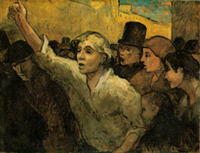
Text sources: Available on request.  Image: Honore Daumier, “The Uprising” – Wiki Commons

Post to Twitter Tweet This Post

What History Will Not Teach Us

The great historian of our age, Newt Gingrich, declared during an interview August 16, 2010 on Fox News’s Fox and Friends, that “Nazis don’t have the right to put up a sign next to the Holocaust Museum in Washington” so “there’s no reason for us to accept a mosque next to the World Trade Center.” Let’s set aside for a moment the fact that a proposed Islamic cultural center would be built blocks away from the former World Trade Center site; that terrorism in the name of Islam and Islam are not one and the same; and that our Constitution could be interpreted to permit an expression of Nazi opinion “next to” a museum in the nation’s capital. Gingrich was offering a receptive audience a lesson in historical analogies, opining that the Nazi program exterminating 6 million of Europe’s Jews and other non-Aryans is analogous to the infamous September 11 bombing of the World Trade Center, which claimed the lives of Muslims as well as “white” New Yorkers.

Joining Gingrich as another one of the nation’s eminent history teachers, talk show host and Fox News commentator Glenn Beck organized a rally of tens of thousands for August 28 at the Lincoln Memorial as a latter-day civil rights assembly. That was the site, 47 years ago to the day, where Martin Luther King delivered his “I have a dream” speech to the multitudes gathered for the March on Washington for Jobs and Freedom.  Beck aspires to reclaim the civil rights movement from “progressives” and black America, which he complains have co-opted the movement with their disdain for “white culture.”

Let’s also set aside the fact that the “white culture” which Beck champions gave us not only patriotic, freedom loving, and small town Americans, but also the Ku Klux Klan, our very own native terrorist organization.  Between its founding during Reconstruction and its peak during the 1920s, the KKK has claimed over 4 million advocates of “white culture.” (You can still join up on-line at one of several KKK websites.) Victims of the Klan’s violence under the cover of darkness included such notable enemies of “white culture” as (besides blacks) Catholics, Jews, foreigners, and organized labor.  We can also set aside the fact that the 1963 March on Washington was in every respect animated by a progressive political agenda, as its name suggests.

Less flamboyant, but hardly less earnest, Wall Street Journal columnist John Fund also taught some history to a Maine Republican Liberty Caucus clambake August 26.  Guests learned from Fund that the ‘tea party movement’ is analogous to “another populist grassroots movement: the left’s antiwar campaign during Vietnam [sic].”  We’ll set aside the fact that east and west coast college and university campuses, where the antiwar movement gathered most of its steam, were not the spawning grounds of ‘populist grassroots’ movements in the 1960s or any other decade in U.S. history.  We’ll also set aside the fact that on the substance of their respective issues, Glenn Beck and the late William Sloan Coffin, religious leader of the anti-war movement, represent opposite corners of our religious and political landscape.

History is to societies what memories are to individuals; it offers a past which we can use to rationalize or explain the present.  Unfortunately, history also waits to be exploited by those who lack well-informed or reasoned arguments for their claims on the rest of us. The putative lessons of history have been used for moral and political persuasion since Thucydides and Plutarch who, in turn, supplied some history lessons to the founders of the United States.  Were such lessons merely rhetorical decoration, questions of their accuracy might remain academic.  But such ‘lessons’ have often been the basis of misguided policies as well as virulent politics.

The belief that our historical experiences could be scientifically captured and understood–another one of Francis Bacon’s promises–tantalized thinkers and writers from the 18th century Enlightenment until well into the 20th century.  The conviction that scientific accuracy might be reached through a reliance on the measurement of ‘objective’ data–or quantitative history–resulted in a preference for varieties of historical evidence that could be counted, such as tax records and population statistics.  Few historians working during the 1970s can forget the uproar over Robert Fogel’s 1974 Time on the Cross, a quantitative history of American negro slavery, in which Fogel concluded that–whatever its moral failings–slavery was economically profitable.

Well before Fogel wrote, however, physicist Thomas S. Kuhn and philosopher Karl Popper undermined the belief that science could produce indisputably valid knowledge of our world, whether by counting measurable things or not.  Thus depleted of its theoretical underpinnings, scientific history lost much of its following in the ensuing decades, while ‘social constructionists’ began to treat all historical narratives as the self-serving products of prevailing social groups.

Neither the scientific nor the social constructionist views of what history might teach got it right.  Definitive scientific truth does not and cannot exist for the simple reason that before the sun sets tomorrow we could have stumbled upon entirely new and contrary evidence.  And so it is with historical conclusions, however ‘objective.’  On the other hand, some things indisputably did happen yesterday and the day before, and those happenings were not socially invented.  A fatal automobile wreck was not a socially invented or biased truth to the person killed in it, and the newborn infant is not a socially invented truth to its parents.  Both events, initially small in apparent importance to the rest of us, could have vast potential consequences, depending upon what happens as a result in the years that follow.

What historians do–real ones, that is–is gather evidence to produce narrative explanations of certain events; their work is comparable to what good trial attorneys do as they prepare their cases for a court hearing.  Such cases–built on narrative explanations–can be dry or unpersuasive, or they can be compelling on the basis of the evidence.  But the fact that a court finds one account of an event persuasive and thus ‘true,’ does not mean that all similar events will be true either in the same way or to the same extent, or that the actions of those involved found comparably virtuous or despicable.  Before the sun sets tomorrow, new evidence may appear, or new circumstances arise, that will lead to an appeal of a court’s ruling. Similarly, new evidence or new readings of existing evidence may send historians back into the archives or on the road in search of a different retelling of the previously accepted narrative.

Thus the fallacy of George Santayana’s maxim, too often quoted by historians in defense of our profession: “Those who cannot remember the past are condemned to repeat it.”  Indeed, we should remember the past, and study it well; but what we acquire from that study is not a map of the future and our best path through it.  What we acquire is a realization of the breadth and complexity of human happenings, and the vast possibilities and uncertainties that lie before us. Not to appreciate the enormity of those possibilities, and thus to be gravely misled by our misconceived certainties, is fortune’s punishment for abusing our past.

~~~~~~~~~~~~~~~~~~~~~~~~~~~~~~~~~~~~~~~~~~~~~~~~~~~~~

Text sources: Available on request.

Post to Twitter Tweet This Post

Creativity Rocks!

Not to be outdone by the ‘hard sciences,’ since the late 19th century psychology has been dominated by positivism–the belief that the mind can be understood by science, using experiment and measurement to prove theories, which are then accepted as laws.

Unlike medically trained psychiatrists who are expected to relieve mental illnesses, psychologists grew their  discipline in academia, where ‘scientific’ was the essential requirement for respected and authoritative conference papers and journal publications–the premium fuel of successful academic careers.

But doing science in academia requires money for psychologists no less than for physicists and chemists and geologists.  World War II brought an unprecedented infusion of money into university science departments and research laboratories, while the industrial and technological expansion that followed ensured their growth as producers of graduate students and post-docs in mathematics, physics, and other natural sciences.  Psychology was able to enjoy a special niche, thanks to the military services which scrambled to populate their ranks with mentally as well as physically fit inductees.

While historians, political scientists, and philosophers had to content themselves with survival in liberal arts colleges and more modest resources in university graduate schools, psychologists were able to take advantage of a post-War flood of shareholder and taxpayer dollars hunting for sure ways to increase productivity in both private and public sector organizations struggling with the managerial demands of a rapidly expanded economy and federal sector.  Increasing productivity required, among other things, skill in identifying and bending compliant subordinates to the various tasks required of them.

Enter the human resources (HR) management enterprise, joined by an army of consultants feeding on human resource managers’ desire for ‘expertise’ to guarantee their own success.  Happily for HR managers, psychologists–scientists of human behavior–were ready.  Thus the many memorable cultural phenomena of the 1960s’ included the successful introduction into organizational management of schemes for the classification, measurement, and training of personalities.  If you can’t define and measure it, you can’t manage it, went (and still goes) the mantra.

Undoubtedly the most familiar of these is the Myers-Briggs personality typology and test developed by Katharine Cook Briggs and Isabel Briggs Myers in the 1940s and 1950s.  Loosely derived from Carl Gustav Jung’s Psychological Types (1923), Myers-Briggs posits four sets of opposite personality ‘preferences’ (Extraversion [sic]/Introversion, Sensing/Intuition, Thinking/Feeling, and Judgment/Perception), which in various combinations can produce 16 different personality types. The Educational Testing Service began to market the Myers-Briggs Type Indicator manual in 1962 after which it was widely adopted in the human resources and management training industries.  (Today Internet “match-making” sites such as eHarmony.com have enabled many more millions to sample the new-old ‘science’ of characterizing personalities.)

One has to experience the Myers-Briggs test to appreciate its fallacious appeal.  Relying as it does on individuals’ self-characterizations at a given moment in time, it is certain to produce distortions, beginning with the test subject’s own probably incomplete self-image.  Nor can one verify the test results under identical (constant) and controlled conditions. If the test were only a waste of tax- and shareholder dollars, that might be bad enough.  But it can also harm both the individuals and organizations who believe in and use it.

Individuals might accept as accurate the test’s categorization of themselves, and thus feel obliged to ‘correct’ their own otherwise spontaneous, natural, and healthy attitudes and behavior. Meanwhile, since the test isolates intellectual activity as a ‘preference’ of introverts who prefer to spend time alone, critically thoughtful persons so desperately needed at corporate conference tables are less likely to be welcome in organizations that venerate ‘team players’ and fear gadflies.

Another product of the positivist ‘measure and manage’ school of human behavior is the test of ‘creativity.’  Also emerging on the educational scene during the 1960’s, creativity testing’s most notable proponent was Ellis Paul Torrance.  ‘Creativity’ shares with ‘critical thinking skills’ the status of that elusive thing that everybody reveres, especially in educational and organizational cultures uneasy with the challenge of discriminating between good ideas and dumb ideas, and that confuse information with knowledge.

If we can decompose creativity into a standardized and measurable set of tasks, then scientific experts can tell us who and what is ‘creative,’ and develop proper techniques for promoting creativity.  Enthusiasm for personality and creativity tests is  (and remains) part of a larger cultural current that prefers technique and process driven solutions–which can be learned from a manual–to pesky examinations of content, which might require us to tangle with more knowledgeable or better educated persons, the enemies of ordinary people like ourselves.

As recently reported in Newsweek magazine, “the accepted definition of creativity is production of something original and useful, and that’s what’s reflected in the tests.”  Creativity, in this particular version of positivism, is necessarily defined to exclude the arts, which seem to resist scientific capture.  Instead, creativity consists of (1) divergent thinking, or “generating many unique ideas,” and (2) convergent thinking, “or combining those ideas into the best result.”  Never mind the breathtaking hubris and ignorance of human history necessary to suppose that you or I on a given day, and at a given place, can recognize the truly original, “many unique ideas,” and appreciate the combination of ideas that produce “the best result.”

Redefining creativity to exclude the arts reminds one of Richard Hofstadter’s classic account of the recurrent ebbing and flowing in this country for nearly two hundred years of hostility to the arts, “high brow” literature, and music.  In the education establishment in particular, advocates of democratic and useful learning argued that the study of fine art, classical music, and literature, was time wasted on the impractical diversions of elites ill suited to adapt, not to mention contribute, to America’s commercial culture.

This, however, should come as no surprise today in a society whose prevailing preoccupations preclude an appreciation of the necessity of varied languages to the adequate furnishing of an educated mind–not to mention negotiating a global society.  No less than “foreign” languages, the visual arts, music and the finest writing, are historically developed languages that enable us to share in the totality of human experience and possibility over time.  The mentality that hustles creativity tests has little or nothing to teach us about the mystery, miracle and fortune–the concatenations of events, forces, and sheer timing–that shape the todays and tomorrows of all of us.

To learn the content and power of human creativity, absorb the beauty of right proportions from the architecture of William Byrd’s “Westover” (built ca. 1730);  hear the depth of grief and dawning of hope in Gregorio Allegri’s (1582-1652) Latin setting of Psalm 51, “Misere Mei Deus;” or begin to glimpse the infinite complexity of human history as it teeters ever on the cusp of chaos in Leo Tolstoy’s War and Peace (1863-69). Thanks to one of the greatest realizations of Francis Bacon’s promise–the democratizing Internet–all of us can hear Allegri’s celestial music performed by many varied voices, or see the perfect repose of the design of Westover.  For War and Peace, however, I recommend picking up the book.

For all of this we need no handbooks, no standardized tests. For all of this there are no meaningful measurements, other than the numbers of lives enriched by true human creativity, and thus more capable of enriching the lives of others.

~~~~~~~~~~~~~~~~~~~~~~~~~~~~~~~~~~~~~~~~~~~~~~~~~~~~~~~~~~~~~~~~~~~~~~
Text Sources: Available on request.

Post to Twitter Tweet This Post

‘Climategate’ Redux

Occasionally politicians,* for whom constituent interests are normally paramount, must remind scientists that the public’s reverence for science can not be assumed.  Such was the case recently after someone in November 2009 hacked into a server used by the Climate Research Unit (CRU) at the publicly funded University of East Anglia, a little over 100 miles northeast of London. Thousands of documents, including e-mails, appeared on various Internet sites whereupon critics of the anthropogenic global warming thesis noisily sought to use the hacked material to discredit it.

One need not be especially cantankerous to observe that  anthropogenic global warming is a compound proposition, consisting of not one but two principal elements, one of which is much more difficult to prove than the other.  It may be indeed true that a steady increase in global temperatures over time can be shown by a mountain of systematically collected quantifiable evidence.  However, verifying the nature and extent of discrete human causes of such a phenomenon is a far more complex matter. There are numerous variables in such a process, many of which are interactive, and all of which are difficult to isolate from the others. The computer coded algorithms on which most such theses rely are no more nor less than highly sophisticated exercises in statistics. And even the best educated among us occasionally confuse statistical correlation with causation.

In response to the ‘global warming’  tumult in cyberspace, widely dubbed “Climategate,”** during the early months of 2010 various august persons and organizations investigated allegations that the hacked data and e-mails revealed manipulation of evidence and a conspiracy to unlawfully withhold data to protect the CRU scientists’ conclusions from public scrutiny.  These inquiries prudently avoided investigating or debating the merits of the anthropogenic global warming thesis itself. The resulting reports focused instead on (1) whether the scientists had adhered to “standard scientific practice” in managing their climate data and computer codes; and (2) whether CRU researchers had attempted to prevent the release of data and e-mails responsive to lawful requests under the UK’s Freedom of Information Act.

Now, let’s pause to consider an interest far more important than the the careers of the ‘Climategate’ combatants, and certainly no less significant for human society in the long term than the persistent warming of the planet.

Scientists traditionally look to the fellows of their guild to judge the validity of their work (‘peer review’), arguing that only scientists can judge science.  But scientists are not only members of their profession.  Most are also members of a form of civil society wherein actions are judged and policy is made on the basis of constitutionally adopted and publicly –openly– administered principles and laws.  What’s more, there are likely to be policymakers both here and in the UK who are the intellectual peers of the best scientists practicing.

Those who work with numbers and algorithms, as ‘hard’ scientists and engineers do, are not exceptionally reliable arbiters of qualitative or moral judgments–including their own.  Codifying this view the  U.S. Supreme Court, in a series of cases during the 1990s, affirmed that the judiciary, not scientists–notwithstanding all their peer reviews–determines what is valid evidence in federal law, even when litigation involves scientific or engineering questions.

Likewise, the Freedom of Information Acts of both the UK and the United States do not exempt from public disclosure scientific information per se held by public authorities (of which the University of East Anglia is one).  However, academic research institutions in general and the science establishment in particular–neither of which could survive without regular infusions of public funds–have managed to insert weasel wording into their respective countries’ FOIA regulations allowing them to withhold from disclosure research data salient to matters of public policy.

Here’s how: In 1998 U.S. Senator Richard Shelby (R-Ala) introduced language into the Omnibus Appropriations Act for fiscal year 1999 extending the FOIA to research data produced not only by government researchers, but under federally funded research awards.  During the lengthy federal administrative process of revising legislative implementation guidelines that followed, the National Academy of Sciences, along with various research institutions partially supported by federal research grants and contracts, successfully lobbied the White House Office of Management and Budget to exempt from the FOIA disclosure of research data “necessary to be held confidential by a researcher until they are published, or similar information which is protected under law [e.g., intellectual property or national security information].” Thus did the guild reserve to itself the discretion to reveal the existence of research data acquired with public funds, and to decide whether any of it might be subject to timely public release. The scientific establishment in the U.K. obtained similar language in the U.K.’s corresponding statute.

Returning to ‘Climategate,’ the British Information Commissioner (IC) found that the CRU data at issue was indeed subject to the FOIA and the European Union’s Environmental Information Regulations, enforceable by the IC.  The IC also found that the CRU’s e-mails disclosed by the hacking episode provided prima facie evidence that “some requests for information were considered an imposition, that attempts to circumvent the legislation were considered and that the ethos of openness and transparency the legislation seeks to promote were not universally accepted.”  Unfortunately or fortunately, depending on where one stood, the initial FOIA complaint had not been made within the six-months period required by the statute, and thus the Information Commissioner’s inquiry could not proceed beyond the prima facie evidence.

Meanwhile, the report of the House of Commons Science and Technology Committee, issued March 31, 2010, reproduced “hacked e-mails [which] appear to reveal scientists encouraging their colleagues to resist disclosure and to delete e-mails, apparently to prevent them from being revealed to people making FOIA requests.” Nonetheless it chose to defer to the IC’s necessarily inconclusive inquiry into the alleged University of East Anglia’s FOIA violations.  The committee concluded:  “A great responsibility rests on the shoulders of climate science: to provide the planet’s decision makers with the knowledge they need to secure our future.  The challenge that this poses is extensive and some of these decisions risk our standard of living.  When the prices to pay are so large, the knowledge on which these kinds of decisions are taken had better be right.  The science must be irreproachable.”

This conclusion begs the question of just whose responsibility it is to ensure that the science used to shape public policy decisions is irreproachable.  The answer must be that the responsibility for justifying national policy decisions belongs to the people, through their elected representatives, even when scientific or technical judgments are involved.  (Indeed, in the 21st century few national policy issues lack some scientific or engineering component.) The uses of scientific research in resolving public policy disputes are a matter of judgment.  Such judgments must be made in the public forum, through open and fully informed debate.  Not only is this so as a matter of constitutional principle; it is so because the reality of science is that its truths are not imperfect or immutable. To argue otherwise is to argue doctrine, not experience.

~~~~~~~~~~~~~~~~~~~~~~~~~~~~~~~~~~~~~~~~~~~~~~~~~~~~~~~~~~

* Politician: a policy-maker whose policies one opposes.

** A designation inspired by the 1972 break-in of Democratic Party National Headquarters at the Watergate hotel-office complex in Washington, DC, which became a factor in the downfall of the Nixon presidency.

Text sources: Available on request.

Post to Twitter Tweet This Post