Archive for the ‘Open Systems’ Category

Those of us who oppose allowing Internet service providers to impose tolls on users wanting to use higher broadband transmission speeds are rowing upstream.  This is not only because powerful interests—among them, AT&T, Verizon, and cable companies—want to exploit U.S. policy’s current treatment of Internet access as a commercial commodity, rather than a public utility.

We are also rowing upstream because we are caught in a seemingly inexorable current spreading proprietary capture of the public sphere, a current that has flown with increasing amplitude through Washington since the 1980’s. This is the first of three interrelated posts examining the continuing private enclosure of the public ‘commons’ in this country.

* * *

Shane, Jack Schaefer’s much loved 1949 novel, was brought to movie theaters in 1953 by George Stevens and starred Alan Ladd.  The film was inspired by the Johnson County, Wyoming range war of 1892.   That conflict, which required the U.S. Cavalry to ‘resolve,’ climaxed years of violence among the region’s homesteaders, owners of open ranging cattle, and ranchers who unfurled barbed wires for miles to keep those cattle out.

We now find ourselves in the midst of a new enclosure movement.  While not lending itself to novels and films, it is changing this country’s political economy in ways no less historic and profound.  Unlike prairie grass, what is being enclosed is invisible.  Its absence is unlikely to be missed until the political, cultural, and economic consequences of its loss are felt.

Slowly being enclosed behind proprietary fences today is public information necessary to policy debate.  Paralleling this new enclosure is the gradual proprietary capture of publicly developed intellectual capital vital to our material progress.   With the election in 1980 of Ronald Reagan the nation transitioned from a democracy of citizens toward “monetized democracy,” a transition implicit in  the widespread and generally bi-partisan belief that democracy and free-market capitalism are mutually inseparable.   The currency of this new political economy is information.

Since the mid-20th century public access to government information in the United States has been protected by ‘sunshine’ or open-access laws.  Their foundations were laid in the 1940s during the federal government’s rapid expansion in response to the demands of the Great Depression and World War II.  Ten years in the making, the Administrative Procedures Act of 1946 sought to ensure openness and transparency in the operations of dozens of federal agencies.

The Freedom of Information Act of 1966 (et. seq.), which began life as an amendment to the 1946 legislation, has served as a model for similar state laws.  A companion measure, the Federal Advisory Committee Act (FACA) of 1972, arose from fears first voiced in the 1950s that industry groups and well-heeled political donors were capturing policy-making behind closed doors in secret federal ‘advisory committee’ meetings.

That such fears were justified was publicized in 2002 when the press reported that 18 of the energy industry’s 25 most generous donors to the 2000 Republican presidential campaign met with Vice-President Cheney’s energy task force, which subsequently produced a supply-side energy policy favoring more oil and gas drilling, along with construction of well over a thousand electric plants powered largely by coal.[i] A federal appeals court ruling in May, 2005 accepted Cheney’s argument that the FACA did not apply to Cheney’s visitors from the oil, coal and gas industries, who were not technically members of the energy task force.

In an earlier FACA case involving the Clinton administration’s National Health Care Reform task force, the White House asserted that the FACA did not apply to its meetings because “the working group was so massive, fluid, and disorganized, that it lacked the structure, organization, and fixed membership that are essential to a FACA committee.”[ii] In 1994, before the federal district court could try the case, the White House mooted it by publicly releasing all the working group documents.  In both instances technical readings or applications of the FACA weakened the ostensible intent of the law, which was to reduce the disproportionate power of insiders to influence the shaping of policy choices.

The belief that greater “sunshine” over the operations of government would ensure greater participation in policy-making has turned out to be naive.  The effectiveness of the FOIA and the FACA at ensuring openness is necessarily limited, since government lawyers’ clients have deeper pockets than most “sunshine” litigants—unless they happen to be large institutions not favored by the current administration—and are well-equipped to argue government secrecy cases on technicalities (e.g., when is a First Lady a federal employee?).  And there is always the possibility that the government will settle a case without acknowledging wrong, and insist on a silencing “gag” order on plaintiffs in a settlement.  To paraphrase former Secretary of Defense Donald Rumsfeld,  “we will never know what we didn’t know or don’t now know.”

Yet powerful commercial or political interests have no monopoly on subverting openness in the conduct of the people’s business, or imaginative ways in doing so.  In 1997 the Supreme Court let stand a lower court ruling that the 600-odd advisory committees operated by the federally chartered National Academy of Sciences are not subject to the FACA.  Yet most, of the Academy’s work is funded primarily by tax dollars through contracts with federal agencies, much of which is accomplished by convening and operating advisory committees of scientific experts. (The definition of ‘advisory committee’ rests on its non-operational or non-executive functions.)

The Academy argued—as do most claims for exemption from the FACA’s open meeting requirement—that advisors must feel free to give candid advice to the President and government officials.  Many observers accept this argument—thus revealing the extent to which the precept of ‘attorney-client privilege’ has migrated into government officialdom, which is historically rich in attorneys.[iii]

But one must ask:  Setting aside genuinely private or national security matters, what sort of knowledge necessary for informed government action should not, could not, or ought not, be made public?  Are we citizens not the ultimate clients for any substantive policy discussions occurring in our name?  What ethical or judicial code enshrines the notion that candor and honesty require concealment?

This trend has also been accompanied by the enclosure of a democracy’s other essential asset:  the proprietary capture of public intellectual capital.  (See following post, The New Enclosure-Part II).


[i] Don van Natta, Jr. and Neela Banarjee, “Top G,O,P, donors in Energy Industry Met Cheney Panel,” New York Times (March 1, 2002); Abramowitz, Michael; Steven Mufson, “Papers Detail Industry’s Role in Cheney’s Energy Report,” Washington Post (July 18, 2007).

[ii] “Association of American Physicians and Surgeons, Inc. et. Al. v. Clinton, et. Al., 989 F. Supp. 8 (D.D.C. 1997), FACA Case Digest, Federal Interagency Databases Online, downloaded January 4, 2009.

[iii] In a partial victory for the public, legislative language consistent with the FACA provided by Rep. Henry A. Waxman (D-CA) specified that the Academy would still be expected to publish the names of committee members, avoid conflicts of interest among committee members, and ensure that a balance of interests is represented on its committees.

Post to Twitter Tweet This Post

The New Enclosure (Part II)

The notion that the things we create belong to us is not new; it dates back at least to 560, when Ireland’s King Diarrmait ruled against the monk Colmcille, who had secretly copied his mentor Finnian’s psalter.  (Legend records Diarmait’s judgment as “To every cow belongs her calf, therefore to every book belongs its copy.”)

But that is not how President Andrew Jackson’s appointee to the U.S. Supreme Court Justice John McLean applied the principle in his majority opinion in Wheaton v. Peters (1834).  Scholars can debate whether ownership of one’s own original works is in fact a natural or common law right, as King Diarmait supposed, or whether it is a privilege granted by the sovereign.[i] But Justice McLean could find in the United States no common law right to the exclusive use of one’s creations.

At issue was whether Henry Wheaton enjoyed a common law copyright in the annotated  reports, with opinions, of the Supreme Court that he had prepared and published, a copyright that Richard Peters had violated when he published cheaper, abridged editions of  Wheaton’s reports.

Two lower courts had held, as McLean would affirm, that:

“It is clear there can be no common law of the United States. The federal    government is composed of twenty-four sovereign and independent states, each of which may have its local usages, customs, and common law. There is no principle which pervades the union and has the authority of law that is not embodied in the Constitution or laws of the union.”[ii]

Only the Congress, by virtue of section eight of the first article of the Constitution, has the power “to promote the progress of science and useful arts, by securing for limited times, to authors and inventors, the exclusive right to their respective writings and discoveries.”  “Congress,” wrote McLean, “by the act of 1790, instead of sanctioning an existing perpetual right in an author in his works, created the right, secured for a limited time, by the provisions of that law.”[iii]

And then, at the end of his majority opinion, McLean added:

“It may be proper to remark that the Court is unanimously of opinion that no reporter has or can have any copyright in the written opinions delivered by this Court, and that the judges thereof cannot confer on any reporter any such right.”

Thus it was that the U.S. Supreme Court established, almost as an afterthought, that the information generated by those in whom the “People of the United States” have vested their  legislative, executive, and judicial powers, belongs to the people of the United States, and that any proprietary right in that information can be granted only by the Congress, as provided in Article I, Section 8.

In the modern world intellectual capital is the purest coin of any realm.  No less than the metallic coin of economics, its greatest social benefits accrue from widespread accumulation and circulation.  Before World War II the largest accumulation of intellectual capital owned by the federal government took the form of census data, information gathered by regulatory agencies, and scientific and technical information collected by the departments of Agriculture, Interior, the US navy, army, and coast guard.  Of comparable value for the continuation of democracy was the growing body of  interrelated reports prepared by the legislative, judicial, and executive branches of government and their administrative agencies.

World War II and the Cold War resulted in the unprecedented expansion of publicly directed and funded research. Federal investments in research and development (R&D) increased at over twice the rate of the total federal budget between 1940 and 1980.  This research produced new ideas and knowledge—information necessary for effective understanding and action—of inestimable value.

Most of those federal dollars—which grew from $186 million in 1940 to over $72 billion in 2000—flowed as contracts and grants  through the procurement offices of the departments of defense and energy, the National Institutes of Health, and the National Aeronautics and Space Administration.   Those dollars then began to substantially support the budgets of an expanding aerospace and healthcare industry, as well as research universities. The accumulated skills of these private sector institutions at obtaining federal grants and contracts, and their lobbying to sustain the federal research and development programs that produced them, ensured that they would receive the lion’s share of the public’s R&D investment for decades to come.

At the start of the 21st century three fourths or more of the R&D budgets at each of the principal federal research and development agencies[iv] went to a relatively small group of corporations that included such familiar heavy-hitters as Lockheed-Martin, Boeing (which absorbed McDonnell Douglas in 1997), Raytheon, Bechtel, TRW, and Science Applications International.  Beneficiaries among academic institutions included the universities of California, Michigan and Washington, Columbia, Stanford, and the Johns Hopkins University.

Before the 1980s, once a sponsoring agency obtained information from a recipient of one of its research grants or contracts,  members of the public could, in turn, request that information under the federal Freedom of Information Act or FOIA (subject to the usual privacy or national security exemptions).  Most agencies, however, settled for research reports, accepting their contractors’ or grantees’ claims that data must be withheld from the public in order to protect the identity of human research subjects, sequester data prior to its publication in peer-reviewed research journals, or to protect the data’s potential proprietary value.

Waiving delivery of research data as a matter of policy received the imprimatur of the U.S. Supreme Court in 1980, when it ruled (in Forsham v. Harris) that if a federal agency did not actually create or obtain research data itself, such data could not be considered federal records and subject to the FOIA.  Forsham was a boon to academic research institutions that had wandered from their ideological moorings of disinterested science into the sporty waters of high-technology business, a process well-captured in Daniel S. Greenberg’s Science for Sale: The Perils, Rewards, and Delusions of Campus Capitalism (2007).

Then, critics of the national air quality standards released by the Environmental Protection Agency in 1997 during the Clinton administration, led by Senator Richard Shelby (R-AL), complained that not only would the standards burden industry with ruinously high compliance costs, but several studies of toxic effects of air and water pollutants had later proven faulty.  Thus, given their serious policy consequences, data collected by the EPA for setting its standards should be available for public inspection.  Shelby attached to the Omnibus Appropriations Act for fiscal year (FY) 1999 an amendment requiring federal agencies to disclose “all data produced under a [federally funded research] award.”  The scientific community arose in alarm.[v]

Led by the National Academy of Sciences, the scientific establishment persuaded the White House’s Office of Management and Budget (OMB, which oversees the writing of regulatory language implementing federal statutes) to define research data subject to public disclosure in a way that would serve its expanding proprietary interests.  The OMB ultimately excluded from research data subject to FOIA disclosure any data supporting regulations having an impact of less than $100 million, and “materials necessary to be held confidential by a researcher until they are published, or similar information which is protected under law” (e.g., intellectual property.)  The Shelby amendment, once it emerged from OMB’s process, had a lethal weakness: What constituted research “data” under OMB’s ‘clarifying’ definitions could be determined only by those who held it, viz., the same research scientists wanting to retain the data for their own uses.[vi]

Just how important public access to the results of its own investment in intellectual capital had become was evident with the completion in 2000 of the joint U.S. and British Human Genome Project.  Prime Minister Tony Blair’s and President Bill Clinton’s joint statement that “the genome should be made freely available to scientists everywhere” sent bio-technology stocks plummeting.  Investors had concluded that the federal government would oppose patenting human genomic data.  In a hasty effort at damage control, the White House urged the securities markets to read the leaders’ joint statement more carefully, where they would find: “Intellectual property protection for gene-based inventions will also play an important role in stimulating the development of important new health care products.”[vii] (To continue reading about the proprietary capture of public intellectual capital, see The New Enclosure-Part III).


[i] Adam Mossoff, “Who Cares What Thomas Jefferson Thought about Patents?  Reevaluating the Patent ‘Privilege’ in Historical Context,”  Cornell Law Review, Vol. 92, No. 953 (2007).

[ii] U.S. Supreme Court, Wheaton v. Peters, 33 U.S. (8 Pet.) 591 (1834).

[iii] U.S. Supreme Court, Wheaton v. Peters, 33 U.S. (8 Pet.) 591 (1834).

[iv] Departments of Defense and Energy, the National Science Foundation, National Institutes of Health, and the National Aeronautics and Space Administration.

[v] National Research Council, Bits of Power: Issues in Global Access to Scientific Data (Washington, DC: National Research Council, 1997).

[vi] Sylvia Kraemer, Science and Technology Policy in the United States: Open Systems in Action (Rutgers Univesity Press, 2006, pp. 102-108.

[vii] White House Office of Science and Technology Policy, “Joint Statement by President Clinton and Prime Minister Tony Blair of the U.K.,” March 14, 2000.  Alex Berenson and Nicholas Wade, “The Markets: Stocks & Bonds; A Call for Sharing of Research Causes Gene Stocks to Plunge,” The New York Times (March 15, 2000).

Post to Twitter Tweet This Post

The New Enclosure (Part III)


Discussions of patent policy in the United States and elsewhere often overlook the fact that the original intent of issuing patents (not to be confused with sovereign-granted commercial privileges) was to encourage the disclosure and spread of novel devices to stimulate manufacturing and trade.  The earliest patents (such as those awarded by the Republic of Venice in the 15th century) were designed for this purpose.

Patents issued to the U.S. government were comparatively few before World War II.  (Military contractors typically retained patent rights by default.)  By the height of U.S. involvement in World War II, research in federal laboratories, along with industry contracts with the military services, had contributed to a ten-fold increase in federal government patents.

Until the 1980s federal policy treated most of the intellectual property produced by research funded with public dollars as presumptive public property.  Using royalty-free licenses issued by federal research agencies, the private sector could develop and market products incorporating information contained in federally owned patents.

When Congress created the Atomic Energy Commission (AEC) in 1946, the national security ramifications of the AEC’s work meant that the federal government would remain the owner of inventions produced by the AEC’s private sector contractors as well as in its own government operated laboratories.  Four years later, the first uniform federal government-wide patent policy, issued by President Truman, extended the AEC’s patent policy to any invention made by a federal employee, “on government time,” or with federal dollars.

Neither then, nor now, has anyone seriously argued that the federal government is equipped to compete with the business sector, nor that it should, by itself, attempt to commercialize the innovative products that could result from federally funded research.  But as the tensions of the Cold War began to subside, fewer and fewer members of Congress questioned whether taxpayers should have to pay twice for marketable innovations based on public intellectual property.

The pro-business Republican ideology that carried Ronald Reagan into the White House in 1980 embraced the notion that taxpayers could pay for the research that produced innovations, and then pay again for those innovations when they appeared in the marketplace.  Meanwhile, corporate interests that did indeed finance the risk of product development and marketing, complained that government contributed nothing but impediments to American technological progress.  And so a moral barrier between private lucre and public good began to weaken against political pressure to “commercialize” the public’s intellectual capital.

Most economists agreed with Attorney General Nicholas Katzenbach when he told the Senate Small Business Committee in 1965 that he knew of no “data, studies, or facts of any kind at all which could possibly support” the notion that giving patent rights to federal contractors would “foster the prompt working of inventions.”[i]

Notwithstanding the conclusions of numerous economists and his own Attorney General, when President Kennedy issued patent policy guidelines to executive branch agencies, buried in the policy language was a subtle transfer of the public’s presumptive intellectual property rights to the private sector.  Kennedy’s policy directed that if two or more potential government contractors offered otherwise competitive proposals, “the willingness to grant the government principal or exclusive rights in resulting inventions will be an additional factor in the evaluation of proposals.”[ii] Thus might the public obtain what it had previously owned.  The die was cast.

A bi-partisan consensus emerged (and persists) supporting the enclosure by the private sector of publicly generated intellectual capital in the unsubstantiated belief that commercializing all scientific discoveries is in the public interest, and that patents singularly motivate the development and marketing of innovative products.  This consensus enabled the Nixon administration to allow government agencies to grant exclusive licenses to commercial developers of inventions covered by federal patents, patent applications, or government contracts (subject to a loose array of criteria likely to be met by anyone seeking such a license).  Also enjoying bi-partisan support were the 1980 “Bayh-Dole” amendments to the patent and trademark laws, which invited non-profit organizations and small businesses to “elect to retain title” to inventions made under a federal contract or grant.

The credulity of the Congress and the White House in allowing the steady enclosure—or proprietary capture—of the public’s intellectual property created through research and development funded by the federal government was rationalized in two ways.  First was the argument that the private sector was better suited to commercializing marketable innovations, an argument that could have been met through licensing rather than transfers of patent ownership.  Second was the expectation that patent ownership would ensure public disclosure and dissemination of the knowledge embedded in a newly patented invention.

However, suppose the recipient of a right to patent fails to patent the invention, instead concealing the invention as a trade secret?  Then the intellectual capital is irretrievably lost from the public ‘commons’ as well as public ownership.  Its absence is unknowable, and its loss invisible.  By the end of the 20th century, concluded the Government Accounting Office, the principal federal research agencies (DOD, NSF, NIH, NASA and the DOE) were unable to account for over two thirds of the more than 1,700 patents issued by the US Patent and Trademark Office as government-originated inventions.  Nor had NASA and DOE effectively tracked the outcomes of patent rights waived to their contractors and grantees.[iii]

Economists have been unable to isolate a singularly significant causal relationship between patent ownership and the successful commercialization of innovations.  Effective capitalization, systems integration, exploitation of tacit knowledge, and mastery of production and marketing strategies, along with the ability to pursue incremental product improvements, matter as much if not more than patent ownership.  The most promising business model may require universal adoption, rather than monopoly control, of system components—consider the open system VHS videocassette recorder, or the USB (universal serial bus) that standardized the market for all kinds of computer peripherals.

Far from promoting technological innovation, intellectual property itself can be the basis of an income stream of license fees or royalties, secure corporate debt, or deployed to “corner the market” with patent pools that capture for investors monopoly control over the critical technologies in an industry as well as known alternatives.  “Patents have recently become hot property,” noted Forbes in 2005, enabling small companies “armed with patents but little or no product” to fill their coffers with the fruits of their victories in patent infringement suits against “large business.”[iv]

Indeed, an ‘explosion’ of patenting since the early 1980‘s could be doing more harm than good.[v] Michael Heller’s The Gridlock Economy:  How Too Much Ownership Wrecks Markets, Stops Innovation, and Costs Lives (Basic Books, 2008) contributes to the growing disenchantment with the lucre-driven private sector lionized by Ayn Rand and Ronald Reagan.  The financial crisis of 2008 showed that the private sector cannot even manage its own greed.

The Congress’s decades long conversion of publicly generated intellectual capital into the private sector’s intangible assets has accomplished something only a few might have intended: the engorgement of investment portfolios with a ‘wealth’ of mysterious, if not vaporous, intellectual property.  Securities, analogous to bundled mortgages, promise revenue streams from intangible assets, e.g., royalties for the use of copyrighted materials and licenses for the use of patented technologies.[vi] Notwithstanding the enormous challenge of valuing securities that bundle patents or patent rights (a challenge that has spawned yet another new field of financial acrobatics, ‘intangible property valuation.’[vii]), intellectual property has grown as a significant component of the asset base of the S&P 500.

Successful democracies combine the most critical intangible asset any society can offer—the free flow of ideas—with the assurance that their citizens will share equitably in the material fruits of their enterprise.  The incremental proprietary capture of the public sphere that we have seen since the 1960’s threatens the free flow of ideas and citizen prosperity in perilous ways for all of us.  The failure of our policy makers—inadequately prodded by our citizens—to ensure an Open Internet may be one of the final nails in the coffin of an authentic American democracy.  (See also post for February 16, 2013, National Public Wi-Fi: Why it Matters to You.)


[i] Katzenbach quoted in The Washington Post, July 30, 1965.

[ii] Federal Register, 28 (200), “John F. Kennedy, Memorandum and Statement on Government Patent Policy,” (October 12, 1963), pp. 10943-46.  Federal inventions with national security significance continue to be presumptively ‘titled’ to the government, typically in the cases of the Department of Energy and NASA, which can, however, waive its patent rights.

[iii] General Accounting Office, “Technology Transfer: Reporting Requirements for Federally Sponsored Inventions Need Revisions,” GAO/RCED-99-242 (August 1999).  Sylvia Kraemer, “Federal Intellectual Property Policy and the History of Technology: The Case of NASA Patents,” History and Technology, Vol. 17 (2001).

[iv] Chad Huston, “Survey of IP Monetization Techniques,” IP Today, Vol. 11, No. 10 (October 2004); Margaret M. Blair, Steven M.H. Wallman, Unseen Wealth: Report of the Brookings Task Force on Intangibles, Brookings Institution Press, 2001; Juergen H. Daum, Intangible Assets and Value Creation (John Wiley and Sons, 2002).  Licensing income from intellectual property grew from $18 million in 1990 to an estimated $500 billion in 2005.

[v] Giovanni Dosi, Luigi Marengo, Corrado Pasquali, “How Much Should Society Fuel the Greed of Innovators: On the Relations Between Appropriability, Opportunities and Rates of Innovation,” LEM [Laboratory of Economics and Management, Sant’Anna School of Advanced Studies] Working Papers, 17 (July 2006); Michael A. Heller and Rebecca S. Eisenbery, “Can Patents Deter Innovation?  The Anti-commons in Biomedical Research,” Science, Vol.280 (May 1, 1998); Adam Jaffe and Josh Lerner, Innovation and Its Discontents (Princeton, 2004); Don E. Kash and William Kingston, “Patents in a World of Complex Technologies,”  Science and Public Policy (February 2001); David Mowery, Richard Nelson, Bhaven N. Sampat, and Arvids A. Ziedonis, “The Growth of Patenting and Licensing by U.S. Universities: An Assessment of the Effects of the Bayh-Dole Act of 1980,”  Research Policy, Vol. 30 (2001); James Surowiecki, “The Open Secret of Success,”  The New Yorker (Mayb12, 2008).

[vi] Karen Richardson, “Bankers Hope for a Reprise of ‘Bowie Bonds,’” The Wall Street Journal (August 23, 2005).

[vii] Stephen Bennett, “The IP Asset Class: Protecting and Unlocking Inherent Value,” Vol. 5, The John Marshall Review of Intellectual Property Law (2006).

Post to Twitter Tweet This Post


A recent proposal by Federal Communications Commission (FCC) chairman, Julius Genachowski, would recover some of the country’s little used radio and TV broadcast radio spectrum in order to create a national public wireless (WiFi) network.  Telecommunications companies, which make money selling data plans to enable smart phone and Wi-Fi computer users to access the Internet, are lobbying against the proposal.

Such a network would, of course, be a boon for countless small businesses and Internet-linked technology developers, not to mention the rest of us.  But Chairman Gnachowski’s  proposal also rests on sound historical and policy precedents.

By international law the federal government is responsible for the private as well as public use within the U.S. of the global radio spectrum—which does not “belong” to anyone any more than the sky or the oceans belong to anyone, not even to “job creators” in the telecom industry.

The digital electronic impulses that bring text and images to the screens of our smart phones and Wi-Fi enabled computers are similar to the analog electromagnetic impulses that Samuel Morse tapped out to send the first telegraph in 1844.  Today those digital electronic information “packets” can travel beyond the wires and cables around and above us, carried into remote places by the invisible radio wave spectrum that encircles our globe.

The need for public regulation of the use of radio waves first became obvious in 1912, when radio communications following the Titanic’s distress signals on the night of April 14 were confused, if not unintelligible, thanks to the swarm of amateur radio operators busily working the airwaves.   Within a year the Congress had established (with the Radio Act of 1912) that the federal government would regulate both wire-line and wire-less communications, a principle which has stood firm for over a century of statutory action and judicial decision-making.

Those of us who do not yet use the Internet with mobile devices may be tempted to dismiss these increasingly ubiquitous gadgets as fads, high-end toys for grown-ups and over-indulged children.  But there is little that we do today that does not at some point involve the use of devices relying on the radio spectrum, from automatic garage door openers to cell phones to the remote controls for our television sets.

More importantly, radio waves provide the essential ‘highways’ to every location for the transmission of news, information, electronic libraries, educational programming, remote medical and research data, and only lastly entertainment.  Once upon a time radio waves sent the news to listeners gathered around brown bakelite boxes.  Millions more now receive over the air the electronic data that produce text and graphics on their touch screens.  And as the technology gets cheaper millions more will join the touch screen world.  The telecommunications industry—AT&T, Verizon, T-Mobile, and others—knows this.

But so does the FCC.  The Internet was built with public funds, for the use of all Americans.  Unless all Americans are able to use it, the open public forum that has served democracy by offering a platform and audience for free speech will become enclosed by proprietary technological and monetary barriers.

The Internet is not intellectually inert.  Each webpage contains information and images selected for it by its website ‘builders,’ people who also decide which links to further—and possibly contrary or controversial—information will be included, or not.  Our best assurance of an Internet that disseminates a continual conversation of new as well as old voices, rather than an ongoing chorus of the like-minded, is a genuinely publicly accessible Wi-Fi network.

Like the operators of all public utilities, Wi-Fi operators will need to receive reasonable compensation as incentives for efficiency and innovation.  But you and I, not industry CEOs, should decide what is reasonable.

The big telecommunications companies will be spending bundles of money to persuade us—and lawmakers—that Wi-Fi is a commercial service coupled to their commercial products, access to which should be priced in the marketplace.  And they will be wrong.


Post to Twitter Tweet This Post

In its article on forced ‘disappearance’ to eliminate political opposition, Wikipedia lists no less than 22 countries where ruling parties have resorted to this practice.  Among the better known are Argentina and Chile, under the regimes of Jorge Rafael Videla (1976-1981) and Augusto Pinochet (1976-1981), respectively.

As a means of eliminating unwelcome political speech, ‘disappearing’ has the advantage of denying the opposition a locus of protest. One day, someone or some thing is simply no longer there.  Who was it? What was it?  No longer noticing, how long before we forget?

We in Maine have also had a small exposure to the (mercifully bloodless) ‘disappearing’ of political speech.  U.S. District Court Chief Justice John A. Woodcock ruled in Newton v. LePage (March 23, 2012) that a mural in the Maine Department of Labor building depicting the history of Maine’s working people, and summarily ‘disappeared’ by Governor Paul LePage, is political (or government) speech:

“…the parties agree and the Court takes as a given that the labor mural projects a message and that that message is speech.” [p. 65] Thus the resolution of the issue of the governor’s removal  of the mural  “rests not in a court of law but in the court of public opinion.”

If our governor’s political speech were merely “blunt,” as he maintains, we might do no more than roll our eyes and move on.  But the most notorious of his one-liners are striking for their tacit violence.  What’s more, the resort to violence to end–rather than resolve–disputes appears normal among some of his supporters.

According to a manager in a Route 1 convenience store, “we like him because he says what we really think.”  Another supporter writing to the Press Herald advises that a columnist critical of LePage would have been “seen … as a smart aleck twit and I think he’d have frequently gotten beat up at school.  And he’d have deserved it.” [Charles Todorich, PPH, July 21, 2012].

The true cost of our governor’s preferred political speech is not the heartburn it surely gives to the Prius and Birkenstock set.  It is that it peremptorily forecloses meaningful and creative efforts to resolve policy disputes with the largest number of our citizens possible.

In business school they call it negotiating a “win-win” solution to a conflict of interests.  In public administration they call it getting “buy-in from as many stakeholders as possible.”  The most important reason to work for consensus is not so we can all feel good about ourselves.  It is so that whatever resolution is ultimately achieved will endure.  Otherwise enough people able to undermine a policy will always be waiting for the chance to do so.  Achieving a “win-win” solution is ‘realpolitik’ at its finest.

For example, Maine has before it two important opportunities to improve and modernize its infrastructure, opportunities critical to our long-term economic vitality.  These are an east-west highway across the state, and universal access to broadband Internet, now possible thanks to the completion of Maine’s first high-speed fiber-optic telecommunications network.

The weight of historical evidence shows that robust transportation and communications networks have been essential to this country’s economic prosperity and political cohesion.  A map of railroad routes built across the U.S. in the 1860’s, routes which headed west, rather than south, reveals a chief reason the southern states failed to benefit from an emerging vigorous national economy and evolved an insular culture and politics that persist in its rural areas to this day.

An east-west highway across Maine would do much to relieve the rural isolation–attractive to some, impoverishing to many–of its northern and western counties.  Some creative mediation by a responsible state government would ensure that the right questions are asked and answered, and the legitimate concerns of the opposition accommodated.

Similarly, Press Herald columnist Charles Lawton has recently written of the challenge facing those who support the extension of broadband throughout Maine.  Too few Mainers appreciate what a computer and broadband Internet access can contribute to their lives (for example, telemedicine), and too few Maine businesses recognize the need today for an active on-line presence to survive–much less grow.  The failure of Maine’s businesses to exploit this essential component of our commercial infrastructure begs for constructive state government involvement, including financial incentives.

But these opportunities–and others of comparable importance–are likely to be lost with this governor, fallen prey to the unfortunate tenor of his political speech.

Post to Twitter Tweet This Post

Shadowboxing

Political rhetoric thrives on fiction, so it should not surprise us that conservatives’ campaign to discredit progressivism–now in full flame during this mid-term election year–brandishes entirely illusory notions of “free market capitalism,” and its supposed enemy, the federal government.  It is a campaign that engages politicians, the media, and citizens who prefer vaporous illusions to grubby truths in a variety of shadow boxing that has distinguished American politics at least since the New Deal.

The coupling of ‘free market capitalism’ with public sector minimalism is one of the great fallacies of today’s debates over what to do to revive the nation’s economy.  Neither Adam Smith, architect of the free market economy in his Wealth of Nations (1776), nor his followers Richard Morris and Alexander Hamilton among this country’s ‘founding fathers’, argued that thriving ‘private sector’ commerce and strong government were mutually opposed.

Smith knew that we could not count on individuals scrambling for profits to grace us with the public goods that make profitable commercial enterprises possible.  Morris and Hamilton understood that a strong, centralized government was essential to the nation’s economic credibility in a world that–even then–was oiled by international finance.  And they understood that only a strong government could create and maintain the “veins of commerce” that give life to a national marketplace.

To appreciate the virtually sacred status of ‘the private sector’ for many Americans one has to recognize that private wealth has become for enterprising and hard working individuals what salvation once was to the pius: the reward for individual striving.  The sociologist Max Weber detected the affinity between individual salvation and private wealth in largely Protestant societies over a century ago.  A quasi-religious veneration of individual striving acquired its power to shape American politics from the near universal acceptance of social darwinism, seemingly verified by our successful expansion across the continent, and our rise to global hegemony in the 20th century.

Social darwinism (‘survival of the fittest’)–a social philosophy more accurately credited to Herbert Spencer–seeks to justify individual striving as necessary to the evolution of the species toward ever ‘higher’ forms (whatever they might be).  A more perfect example of the distortion of a scientific theory to serve a cultural bias can hardly be imagined.

Do individuals survive because they are more fit?  What is it to be ‘fit?’  If ‘fitness’ is adaptation to an environment, is ‘fitness’ necessarily strength, or greater intelligence?  For biological darwinists certain individuals prevail because of random and heritable genetic variations which enable them–again, randomly–to survive whatever environment happens to surround them. ‘Nature’ does not act on informed judgment, selecting survivors because they are stronger, smarter, or otherwise more ‘fit.’

Moreover, social darwinism leads its believers astray by promoting the notion that individual attributes suffice to account for success or failure.  To the contrary, the success or failure of individuals in  life  (not to be confused with football or beauty competitions) can be due to a host of variables having little to do with their efforts or personal qualities.

Horatio Alger’s Ragged Dick (1868) and Ayn Rand’s John Galt of Atlas Shrugged (1957) are wishful fictions.  As heroic cartoons they fail to reflect the numerous interacting variables that shape what we become, among them:  genetic endowment, our material and cultural environment, resources generated by others, and accidents of time and place.

It may be true that a ‘free market’ driven by the profit motive is most likely to call forth the most efficient use of our talents and energies.  But it is not a guarantee of individual or aggregate national wealth of any description, including GDP.   Nor does the GDP measure national well-being, which is better measured by the H.D. I. (the human development index)  which considers such indicators as education, health and life-expectancy along with GDP.

In the history of this country individual striving has been assisted mightily by three advantages:  the cornucopia of natural resources found in the continental United States, waves of immigration and internal migration, and the system of government–with its intellectual foundations set in the values of the 18th century enlightenment and classical republicanism–crafted during a hot summer in Philadelphia in 1787.

This government, which has survived challenges as great as any we observe today, during the 19th century blazed, charted, dredged, surveyed and cleared land and water routes for the national expansion of private commerce; awarded over 130 million acres of public domain to the railroads for rights of way and as security for bond issues; built the Panama Canal; funded over 70% of the airports and expansion of a national air transportation network during the early 20th century; built the interstate highway system; and fulfilled the country’s penchant for exploration with human and robotic journeys from the Moon to the outer reaches or our universe.

The federal government continues to fight wars not only against military adversaries, but against disease and destitution.  Had we left it up to the profit-motive driven private sector to provide  a critical national infrastructure, we’d still be hitching our oxen up to wagons to haul our goods to market.

In 2005 taxpayers from over half of these United States received back from the federal government more dollars in grants and contracts than they paid in federal taxes.  These states include the home states of Sarah Palin, Senators Jim DeMint, Lindsay Graham, Chuck Grassley, James Inhofe, John McCain, and Mitch McConnell, and Representative John Boehner, among numerous other Republicans in congress or eager to get there.

In fact, about 90% of the federal government’s estimated outlays for 2010 will be returned to private sector employers in the form of grants and contracts positioned in every congressional jurisdiction throughout the land. The ‘iron triangle’ binding the interests of members of congress, the executive branch, and private industry is one of the most powerful determinants of who gets what in the U.S. economy.

Our ‘free market’ has no better friend than the federal government, while our inner cities, with all their community organizers, are no match for US businesses in feeding at the public trough.   Shadowboxing may, alas, garner conservative candidates some votes, but it will not prepare them for the genuine issues that await them in Washington.

~~~~~~~~~~~~~~~~~~~~~~~~~~~~~~~~~~~~~~~

Text sources: Available on request.

Post to Twitter Tweet This Post

Let Us Eat Cake

Poor Marie Antoinette, Queen of France.  ‘You Tube’ has no video of her saying it, so we can’t be sure whether she ever did say “let them eat cake” (or “brioche,” for you purists). Marie was responding to the news on the eve of the French revolution that the people had no bread.  She ate neither bread nor cake after 1793, when hungry and angry Parisian citizens relieved her of her head.  And yet, for all that we do know, the comment was in character–not only for Marie, but for her time.

Fortunately television news  was on hand to confirm that the successful primary election candidate for a U.S. Senate seat from Nevada, Sharron Angle, did declare with comparable indifference that congress should abolish Medicare and Social Security.  (One assumes Ms. Angle and like-minded friends will virtuously forgo the benefits of both.)  When we are old and sick we can eat cake.  Ms. Angle wants us to concentrate instead on our domestic “enemies…who pass these kinds of policies–Obama-care, cap and trade, stimulus, bailouts–they’re certainly not friends to the free market system, they’re not friends.”  Glenn Beck, for his part, includes that nemesis of the free market system, “collectivism,” in the litany of evils he ascribes to Barack Obama’s “belief structure.”

That sacred totem called the ‘free market’ now supports a large tent under which the devotees of Rush Limbaugh, Glenn Beck, and Sarah Palin struggle to override hard conversations about the three most powerful forces that shape American politics: race, region, and class.  The dead give-away is the haste with which their acolytes denounce the “race card” or “class warfare” whenever our current president’s racial heritage, or programs to provide for the greater good, intrude overtly into what passes for political discourse today.

The regions that threaten them are both cultural and geographic: Urbanized regions of the northeast and west coast, inhabited by high-end universities and the “intellectual elites” they produce, people who think it’s important to know what you’re talking about.  A lot of these people, whom they regard as alien to “middle America,” don’t even look and sound like real Americans: Jews, African Americans, Muslims, Latinos, people speaking foreign tongues and practicing strange religions, and of course the New York Times.

If, out of a total U.S. population of 322.3 million, we removed 45.4 million Hispanics or Latinos, 36.3 Blacks or African Americans, and the jumble of  41.1 million of other yellow, red, and brown skinned people, that would leave only 62 percent of the U.S. population who might qualify as “real Americans.” Screen out innumerable homosexuals, 5.7 million Jews, 4.7 million Muslims and readers of the New York Times, and the percentage of ‘real’ Americans gets even smaller.

The Limbaugh-Beck-Palin crowd knows that their views–especially of the nation’s first black president–go against the broad, inclusive grain in contemporary American life, so they masquerade their phobias behind a passion for preserving the ‘free market’ against a supposedly predatory ‘government’ (the same government which, as it serves the Constitution, has allowed the land to become cluttered with all those alien people and their un-American ideas).  After all, who can oppose FREEDOM? Unfortunately, the free market system cannot support the big tent and shelter all the dark fears collected underneath.

One reason is that the architect of the ‘free market’ political economy, Adam Smith, in his The Wealth of Nations (1776) did not view government as a domestic enemy.  To replace an economic model designed to enrich monarchs and their tax collectors (mercantilism), Smith proposed an open economic system of free markets to allocate capital and labor more efficiently (hence, productively), thanks to the market’s automatic regulation of supply and demand.  Like an ‘invisible hand’ it would ensure that capital and labor be turned to their most productive uses, and thus wealth would grow throughout the land.

But Smith was essentially a moralist whose economic views emerged from his moral philosophy.   His Theory of Moral Sentiments (1759) became as popular in its time as Wealth of Nations.  What separated humans from animals, Smith taught, was their inborn capacity for moral judgment and conduct.  This capacity was the source of their naturally occurring moral “sentiments,” which included a preference for the benevolence and justice essential to a moral society.

Smith understood that as the multitudes scramble for profits, they could not be relied on to secure society against the “violence and invasion” of enemies, or to ensure justice, or to carry out the public “duty of erecting and maintaining certain public works and certain public institutions which it can never be in the interest of any individual, or small number of individuals, to erect and maintain.” These things must be done by government.  Adam Smith’s wealthy nation is one in which the opportunity for private wealth does not trump the public good.

Smith, very much a creature of the 18th century, could not have foreseen that his prescription for achieving national wealth would lead to an economic system “red in tooth and claw.”  The Gilded Ages of post-Civil War and post-Reagan America sought to rationalize selfish greed as the competitive energy necessary to create the “richest nation in the world.” What we sowed, we now reap. This nation today finds itself in the midst of an economic crisis of historic proportions, one that is unlikely to end any time soon, while economists and politicians fill op-ed pages and TV screens with prescriptions for cures that shrink from questioning the free market model itself.  Were they to do so, they would be denounced as “communists!”  “socialists!”–or, horrible to contemplate–people who want America to be like Europe!!

Through much of American history the abundance of natural resources and expansion across a vast continent allowed us to believe in our epoch as a time of endless opportunity. Recessions and economic depressions, with their unemployment, lost homes, and millions tumbling backward into poverty, would be mere temporary lags in the economy’s readjustments to the ‘free market’ driven business cycle.

We were, and are, wrong.  Today nearly 15 million people are out of work, a number equivalent to the entire population of the United States in 1835–or to the combined populations of the New York City, Los Angeles, and Chicago, or the combined populations of Alaska, Arizona, Nevada and Utah.  One out of seven Americans has fallen into the slippery sloped depths of poverty, and more are likely to join them in the days ahead. Compounding this widespread failure of our economy to increase national wealth is the failure of the ‘invisible hand’ of the market to distribute what wealth we do generate throughout society to a degree that will be politically sustainable for long.

The disparity in pre-tax incomes between the rich and everyone else is now greater than at any time since the 1920’s.  Of incomes reported on tax-returns, 15 percent of all pre-tax income went to 1 percent of households, with average annual incomes of roughly $800,000.  The top 10 percent of households now receives over 40 percent of total pre-tax income.

Capital investors large and small welcome increases in our GNP and stock market values, not paying much attention to the cruel irony that, by definition, today’s technology-driven productivity requires job losses.   We invent to produce labor saving devices.  In 2009 the CEOs of 50 companies with the largest number of layoffs received 40 percent more pay than their peers elsewhere.

Management consultants tell us that this is a good thing: “it is difficult to fire 6,000 people.  It does help companies survive, so I think you should reward CEOs for doing that.” And rewarded, they are:  In 1982, for every dollar the average worker earned, chief executive officers received $42.  By 2004, chief executive officers were being paid $301 for every dollar paid an average worker.   The free market proposed by Adam Smith now shares with “original sin” this salient characteristic:   At their moments of conception we were innocent of the lives they could waste.  What happened?

The conventional answers are that we should have more (or less) regulation, or more (or less ) government, or more (or less) social spending reinforced by more (or less) taxation.  But even if we could agree on the right balance of all of the above, natural forces endemic to our society and current political system would become our undoing once again.  Stand by for my next post.

~~~~~~~~~~~~~~~~~~~~~~~~~~~~~~~~~~~~~~~~~~~~~~~~~~~~~~~~~~~~~~~~~~~~~~~~~~~~

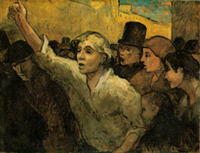
Text sources: Available on request.  Image: Honore Daumier, “The Uprising” – Wiki Commons

Post to Twitter Tweet This Post

‘Climategate’ Redux

Occasionally politicians,* for whom constituent interests are normally paramount, must remind scientists that the public’s reverence for science can not be assumed.  Such was the case recently after someone in November 2009 hacked into a server used by the Climate Research Unit (CRU) at the publicly funded University of East Anglia, a little over 100 miles northeast of London. Thousands of documents, including e-mails, appeared on various Internet sites whereupon critics of the anthropogenic global warming thesis noisily sought to use the hacked material to discredit it.

One need not be especially cantankerous to observe that  anthropogenic global warming is a compound proposition, consisting of not one but two principal elements, one of which is much more difficult to prove than the other.  It may be indeed true that a steady increase in global temperatures over time can be shown by a mountain of systematically collected quantifiable evidence.  However, verifying the nature and extent of discrete human causes of such a phenomenon is a far more complex matter. There are numerous variables in such a process, many of which are interactive, and all of which are difficult to isolate from the others. The computer coded algorithms on which most such theses rely are no more nor less than highly sophisticated exercises in statistics. And even the best educated among us occasionally confuse statistical correlation with causation.

In response to the ‘global warming’  tumult in cyberspace, widely dubbed “Climategate,”** during the early months of 2010 various august persons and organizations investigated allegations that the hacked data and e-mails revealed manipulation of evidence and a conspiracy to unlawfully withhold data to protect the CRU scientists’ conclusions from public scrutiny.  These inquiries prudently avoided investigating or debating the merits of the anthropogenic global warming thesis itself. The resulting reports focused instead on (1) whether the scientists had adhered to “standard scientific practice” in managing their climate data and computer codes; and (2) whether CRU researchers had attempted to prevent the release of data and e-mails responsive to lawful requests under the UK’s Freedom of Information Act.

Now, let’s pause to consider an interest far more important than the the careers of the ‘Climategate’ combatants, and certainly no less significant for human society in the long term than the persistent warming of the planet.

Scientists traditionally look to the fellows of their guild to judge the validity of their work (‘peer review’), arguing that only scientists can judge science.  But scientists are not only members of their profession.  Most are also members of a form of civil society wherein actions are judged and policy is made on the basis of constitutionally adopted and publicly –openly– administered principles and laws.  What’s more, there are likely to be policymakers both here and in the UK who are the intellectual peers of the best scientists practicing.

Those who work with numbers and algorithms, as ‘hard’ scientists and engineers do, are not exceptionally reliable arbiters of qualitative or moral judgments–including their own.  Codifying this view the  U.S. Supreme Court, in a series of cases during the 1990s, affirmed that the judiciary, not scientists–notwithstanding all their peer reviews–determines what is valid evidence in federal law, even when litigation involves scientific or engineering questions.

Likewise, the Freedom of Information Acts of both the UK and the United States do not exempt from public disclosure scientific information per se held by public authorities (of which the University of East Anglia is one).  However, academic research institutions in general and the science establishment in particular–neither of which could survive without regular infusions of public funds–have managed to insert weasel wording into their respective countries’ FOIA regulations allowing them to withhold from disclosure research data salient to matters of public policy.

Here’s how: In 1998 U.S. Senator Richard Shelby (R-Ala) introduced language into the Omnibus Appropriations Act for fiscal year 1999 extending the FOIA to research data produced not only by government researchers, but under federally funded research awards.  During the lengthy federal administrative process of revising legislative implementation guidelines that followed, the National Academy of Sciences, along with various research institutions partially supported by federal research grants and contracts, successfully lobbied the White House Office of Management and Budget to exempt from the FOIA disclosure of research data “necessary to be held confidential by a researcher until they are published, or similar information which is protected under law [e.g., intellectual property or national security information].” Thus did the guild reserve to itself the discretion to reveal the existence of research data acquired with public funds, and to decide whether any of it might be subject to timely public release. The scientific establishment in the U.K. obtained similar language in the U.K.’s corresponding statute.

Returning to ‘Climategate,’ the British Information Commissioner (IC) found that the CRU data at issue was indeed subject to the FOIA and the European Union’s Environmental Information Regulations, enforceable by the IC.  The IC also found that the CRU’s e-mails disclosed by the hacking episode provided prima facie evidence that “some requests for information were considered an imposition, that attempts to circumvent the legislation were considered and that the ethos of openness and transparency the legislation seeks to promote were not universally accepted.”  Unfortunately or fortunately, depending on where one stood, the initial FOIA complaint had not been made within the six-months period required by the statute, and thus the Information Commissioner’s inquiry could not proceed beyond the prima facie evidence.

Meanwhile, the report of the House of Commons Science and Technology Committee, issued March 31, 2010, reproduced “hacked e-mails [which] appear to reveal scientists encouraging their colleagues to resist disclosure and to delete e-mails, apparently to prevent them from being revealed to people making FOIA requests.” Nonetheless it chose to defer to the IC’s necessarily inconclusive inquiry into the alleged University of East Anglia’s FOIA violations.  The committee concluded:  “A great responsibility rests on the shoulders of climate science: to provide the planet’s decision makers with the knowledge they need to secure our future.  The challenge that this poses is extensive and some of these decisions risk our standard of living.  When the prices to pay are so large, the knowledge on which these kinds of decisions are taken had better be right.  The science must be irreproachable.”

This conclusion begs the question of just whose responsibility it is to ensure that the science used to shape public policy decisions is irreproachable.  The answer must be that the responsibility for justifying national policy decisions belongs to the people, through their elected representatives, even when scientific or technical judgments are involved.  (Indeed, in the 21st century few national policy issues lack some scientific or engineering component.) The uses of scientific research in resolving public policy disputes are a matter of judgment.  Such judgments must be made in the public forum, through open and fully informed debate.  Not only is this so as a matter of constitutional principle; it is so because the reality of science is that its truths are not imperfect or immutable. To argue otherwise is to argue doctrine, not experience.

~~~~~~~~~~~~~~~~~~~~~~~~~~~~~~~~~~~~~~~~~~~~~~~~~~~~~~~~~~

* Politician: a policy-maker whose policies one opposes.

** A designation inspired by the 1972 break-in of Democratic Party National Headquarters at the Watergate hotel-office complex in Washington, DC, which became a factor in the downfall of the Nixon presidency.

Text sources: Available on request.

Post to Twitter Tweet This Post