Archive for the ‘Current History’ Category

Those of us who oppose allowing Internet service providers to impose tolls on users wanting to use higher broadband transmission speeds are rowing upstream.  This is not only because powerful interests—among them, AT&T, Verizon, and cable companies—want to exploit U.S. policy’s current treatment of Internet access as a commercial commodity, rather than a public utility.

We are also rowing upstream because we are caught in a seemingly inexorable current spreading proprietary capture of the public sphere, a current that has flown with increasing amplitude through Washington since the 1980’s. This is the first of three interrelated posts examining the continuing private enclosure of the public ‘commons’ in this country.

* * *

Shane, Jack Schaefer’s much loved 1949 novel, was brought to movie theaters in 1953 by George Stevens and starred Alan Ladd.  The film was inspired by the Johnson County, Wyoming range war of 1892.   That conflict, which required the U.S. Cavalry to ‘resolve,’ climaxed years of violence among the region’s homesteaders, owners of open ranging cattle, and ranchers who unfurled barbed wires for miles to keep those cattle out.

We now find ourselves in the midst of a new enclosure movement.  While not lending itself to novels and films, it is changing this country’s political economy in ways no less historic and profound.  Unlike prairie grass, what is being enclosed is invisible.  Its absence is unlikely to be missed until the political, cultural, and economic consequences of its loss are felt.

Slowly being enclosed behind proprietary fences today is public information necessary to policy debate.  Paralleling this new enclosure is the gradual proprietary capture of publicly developed intellectual capital vital to our material progress.   With the election in 1980 of Ronald Reagan the nation transitioned from a democracy of citizens toward “monetized democracy,” a transition implicit in  the widespread and generally bi-partisan belief that democracy and free-market capitalism are mutually inseparable.   The currency of this new political economy is information.

Since the mid-20th century public access to government information in the United States has been protected by ‘sunshine’ or open-access laws.  Their foundations were laid in the 1940s during the federal government’s rapid expansion in response to the demands of the Great Depression and World War II.  Ten years in the making, the Administrative Procedures Act of 1946 sought to ensure openness and transparency in the operations of dozens of federal agencies.

The Freedom of Information Act of 1966 (et. seq.), which began life as an amendment to the 1946 legislation, has served as a model for similar state laws.  A companion measure, the Federal Advisory Committee Act (FACA) of 1972, arose from fears first voiced in the 1950s that industry groups and well-heeled political donors were capturing policy-making behind closed doors in secret federal ‘advisory committee’ meetings.

That such fears were justified was publicized in 2002 when the press reported that 18 of the energy industry’s 25 most generous donors to the 2000 Republican presidential campaign met with Vice-President Cheney’s energy task force, which subsequently produced a supply-side energy policy favoring more oil and gas drilling, along with construction of well over a thousand electric plants powered largely by coal.[i] A federal appeals court ruling in May, 2005 accepted Cheney’s argument that the FACA did not apply to Cheney’s visitors from the oil, coal and gas industries, who were not technically members of the energy task force.

In an earlier FACA case involving the Clinton administration’s National Health Care Reform task force, the White House asserted that the FACA did not apply to its meetings because “the working group was so massive, fluid, and disorganized, that it lacked the structure, organization, and fixed membership that are essential to a FACA committee.”[ii] In 1994, before the federal district court could try the case, the White House mooted it by publicly releasing all the working group documents.  In both instances technical readings or applications of the FACA weakened the ostensible intent of the law, which was to reduce the disproportionate power of insiders to influence the shaping of policy choices.

The belief that greater “sunshine” over the operations of government would ensure greater participation in policy-making has turned out to be naive.  The effectiveness of the FOIA and the FACA at ensuring openness is necessarily limited, since government lawyers’ clients have deeper pockets than most “sunshine” litigants—unless they happen to be large institutions not favored by the current administration—and are well-equipped to argue government secrecy cases on technicalities (e.g., when is a First Lady a federal employee?).  And there is always the possibility that the government will settle a case without acknowledging wrong, and insist on a silencing “gag” order on plaintiffs in a settlement.  To paraphrase former Secretary of Defense Donald Rumsfeld,  “we will never know what we didn’t know or don’t now know.”

Yet powerful commercial or political interests have no monopoly on subverting openness in the conduct of the people’s business, or imaginative ways in doing so.  In 1997 the Supreme Court let stand a lower court ruling that the 600-odd advisory committees operated by the federally chartered National Academy of Sciences are not subject to the FACA.  Yet most, of the Academy’s work is funded primarily by tax dollars through contracts with federal agencies, much of which is accomplished by convening and operating advisory committees of scientific experts. (The definition of ‘advisory committee’ rests on its non-operational or non-executive functions.)

The Academy argued—as do most claims for exemption from the FACA’s open meeting requirement—that advisors must feel free to give candid advice to the President and government officials.  Many observers accept this argument—thus revealing the extent to which the precept of ‘attorney-client privilege’ has migrated into government officialdom, which is historically rich in attorneys.[iii]

But one must ask:  Setting aside genuinely private or national security matters, what sort of knowledge necessary for informed government action should not, could not, or ought not, be made public?  Are we citizens not the ultimate clients for any substantive policy discussions occurring in our name?  What ethical or judicial code enshrines the notion that candor and honesty require concealment?

This trend has also been accompanied by the enclosure of a democracy’s other essential asset:  the proprietary capture of public intellectual capital.  (See following post, The New Enclosure-Part II).


[i] Don van Natta, Jr. and Neela Banarjee, “Top G,O,P, donors in Energy Industry Met Cheney Panel,” New York Times (March 1, 2002); Abramowitz, Michael; Steven Mufson, “Papers Detail Industry’s Role in Cheney’s Energy Report,” Washington Post (July 18, 2007).

[ii] “Association of American Physicians and Surgeons, Inc. et. Al. v. Clinton, et. Al., 989 F. Supp. 8 (D.D.C. 1997), FACA Case Digest, Federal Interagency Databases Online, downloaded January 4, 2009.

[iii] In a partial victory for the public, legislative language consistent with the FACA provided by Rep. Henry A. Waxman (D-CA) specified that the Academy would still be expected to publish the names of committee members, avoid conflicts of interest among committee members, and ensure that a balance of interests is represented on its committees.


Post to Twitter Tweet This Post

The New Enclosure (Part III)


Discussions of patent policy in the United States and elsewhere often overlook the fact that the original intent of issuing patents (not to be confused with sovereign-granted commercial privileges) was to encourage the disclosure and spread of novel devices to stimulate manufacturing and trade.  The earliest patents (such as those awarded by the Republic of Venice in the 15th century) were designed for this purpose.

Patents issued to the U.S. government were comparatively few before World War II.  (Military contractors typically retained patent rights by default.)  By the height of U.S. involvement in World War II, research in federal laboratories, along with industry contracts with the military services, had contributed to a ten-fold increase in federal government patents.

Until the 1980s federal policy treated most of the intellectual property produced by research funded with public dollars as presumptive public property.  Using royalty-free licenses issued by federal research agencies, the private sector could develop and market products incorporating information contained in federally owned patents.

When Congress created the Atomic Energy Commission (AEC) in 1946, the national security ramifications of the AEC’s work meant that the federal government would remain the owner of inventions produced by the AEC’s private sector contractors as well as in its own government operated laboratories.  Four years later, the first uniform federal government-wide patent policy, issued by President Truman, extended the AEC’s patent policy to any invention made by a federal employee, “on government time,” or with federal dollars.

Neither then, nor now, has anyone seriously argued that the federal government is equipped to compete with the business sector, nor that it should, by itself, attempt to commercialize the innovative products that could result from federally funded research.  But as the tensions of the Cold War began to subside, fewer and fewer members of Congress questioned whether taxpayers should have to pay twice for marketable innovations based on public intellectual property.

The pro-business Republican ideology that carried Ronald Reagan into the White House in 1980 embraced the notion that taxpayers could pay for the research that produced innovations, and then pay again for those innovations when they appeared in the marketplace.  Meanwhile, corporate interests that did indeed finance the risk of product development and marketing, complained that government contributed nothing but impediments to American technological progress.  And so a moral barrier between private lucre and public good began to weaken against political pressure to “commercialize” the public’s intellectual capital.

Most economists agreed with Attorney General Nicholas Katzenbach when he told the Senate Small Business Committee in 1965 that he knew of no “data, studies, or facts of any kind at all which could possibly support” the notion that giving patent rights to federal contractors would “foster the prompt working of inventions.”[i]

Notwithstanding the conclusions of numerous economists and his own Attorney General, when President Kennedy issued patent policy guidelines to executive branch agencies, buried in the policy language was a subtle transfer of the public’s presumptive intellectual property rights to the private sector.  Kennedy’s policy directed that if two or more potential government contractors offered otherwise competitive proposals, “the willingness to grant the government principal or exclusive rights in resulting inventions will be an additional factor in the evaluation of proposals.”[ii] Thus might the public obtain what it had previously owned.  The die was cast.

A bi-partisan consensus emerged (and persists) supporting the enclosure by the private sector of publicly generated intellectual capital in the unsubstantiated belief that commercializing all scientific discoveries is in the public interest, and that patents singularly motivate the development and marketing of innovative products.  This consensus enabled the Nixon administration to allow government agencies to grant exclusive licenses to commercial developers of inventions covered by federal patents, patent applications, or government contracts (subject to a loose array of criteria likely to be met by anyone seeking such a license).  Also enjoying bi-partisan support were the 1980 “Bayh-Dole” amendments to the patent and trademark laws, which invited non-profit organizations and small businesses to “elect to retain title” to inventions made under a federal contract or grant.

The credulity of the Congress and the White House in allowing the steady enclosure—or proprietary capture—of the public’s intellectual property created through research and development funded by the federal government was rationalized in two ways.  First was the argument that the private sector was better suited to commercializing marketable innovations, an argument that could have been met through licensing rather than transfers of patent ownership.  Second was the expectation that patent ownership would ensure public disclosure and dissemination of the knowledge embedded in a newly patented invention.

However, suppose the recipient of a right to patent fails to patent the invention, instead concealing the invention as a trade secret?  Then the intellectual capital is irretrievably lost from the public ‘commons’ as well as public ownership.  Its absence is unknowable, and its loss invisible.  By the end of the 20th century, concluded the Government Accounting Office, the principal federal research agencies (DOD, NSF, NIH, NASA and the DOE) were unable to account for over two thirds of the more than 1,700 patents issued by the US Patent and Trademark Office as government-originated inventions.  Nor had NASA and DOE effectively tracked the outcomes of patent rights waived to their contractors and grantees.[iii]

Economists have been unable to isolate a singularly significant causal relationship between patent ownership and the successful commercialization of innovations.  Effective capitalization, systems integration, exploitation of tacit knowledge, and mastery of production and marketing strategies, along with the ability to pursue incremental product improvements, matter as much if not more than patent ownership.  The most promising business model may require universal adoption, rather than monopoly control, of system components—consider the open system VHS videocassette recorder, or the USB (universal serial bus) that standardized the market for all kinds of computer peripherals.

Far from promoting technological innovation, intellectual property itself can be the basis of an income stream of license fees or royalties, secure corporate debt, or deployed to “corner the market” with patent pools that capture for investors monopoly control over the critical technologies in an industry as well as known alternatives.  “Patents have recently become hot property,” noted Forbes in 2005, enabling small companies “armed with patents but little or no product” to fill their coffers with the fruits of their victories in patent infringement suits against “large business.”[iv]

Indeed, an ‘explosion’ of patenting since the early 1980‘s could be doing more harm than good.[v] Michael Heller’s The Gridlock Economy:  How Too Much Ownership Wrecks Markets, Stops Innovation, and Costs Lives (Basic Books, 2008) contributes to the growing disenchantment with the lucre-driven private sector lionized by Ayn Rand and Ronald Reagan.  The financial crisis of 2008 showed that the private sector cannot even manage its own greed.

The Congress’s decades long conversion of publicly generated intellectual capital into the private sector’s intangible assets has accomplished something only a few might have intended: the engorgement of investment portfolios with a ‘wealth’ of mysterious, if not vaporous, intellectual property.  Securities, analogous to bundled mortgages, promise revenue streams from intangible assets, e.g., royalties for the use of copyrighted materials and licenses for the use of patented technologies.[vi] Notwithstanding the enormous challenge of valuing securities that bundle patents or patent rights (a challenge that has spawned yet another new field of financial acrobatics, ‘intangible property valuation.’[vii]), intellectual property has grown as a significant component of the asset base of the S&P 500.

Successful democracies combine the most critical intangible asset any society can offer—the free flow of ideas—with the assurance that their citizens will share equitably in the material fruits of their enterprise.  The incremental proprietary capture of the public sphere that we have seen since the 1960’s threatens the free flow of ideas and citizen prosperity in perilous ways for all of us.  The failure of our policy makers—inadequately prodded by our citizens—to ensure an Open Internet may be one of the final nails in the coffin of an authentic American democracy.  (See also post for February 16, 2013, National Public Wi-Fi: Why it Matters to You.)


[i] Katzenbach quoted in The Washington Post, July 30, 1965.

[ii] Federal Register, 28 (200), “John F. Kennedy, Memorandum and Statement on Government Patent Policy,” (October 12, 1963), pp. 10943-46.  Federal inventions with national security significance continue to be presumptively ‘titled’ to the government, typically in the cases of the Department of Energy and NASA, which can, however, waive its patent rights.

[iii] General Accounting Office, “Technology Transfer: Reporting Requirements for Federally Sponsored Inventions Need Revisions,” GAO/RCED-99-242 (August 1999).  Sylvia Kraemer, “Federal Intellectual Property Policy and the History of Technology: The Case of NASA Patents,” History and Technology, Vol. 17 (2001).

[iv] Chad Huston, “Survey of IP Monetization Techniques,” IP Today, Vol. 11, No. 10 (October 2004); Margaret M. Blair, Steven M.H. Wallman, Unseen Wealth: Report of the Brookings Task Force on Intangibles, Brookings Institution Press, 2001; Juergen H. Daum, Intangible Assets and Value Creation (John Wiley and Sons, 2002).  Licensing income from intellectual property grew from $18 million in 1990 to an estimated $500 billion in 2005.

[v] Giovanni Dosi, Luigi Marengo, Corrado Pasquali, “How Much Should Society Fuel the Greed of Innovators: On the Relations Between Appropriability, Opportunities and Rates of Innovation,” LEM [Laboratory of Economics and Management, Sant’Anna School of Advanced Studies] Working Papers, 17 (July 2006); Michael A. Heller and Rebecca S. Eisenbery, “Can Patents Deter Innovation?  The Anti-commons in Biomedical Research,” Science, Vol.280 (May 1, 1998); Adam Jaffe and Josh Lerner, Innovation and Its Discontents (Princeton, 2004); Don E. Kash and William Kingston, “Patents in a World of Complex Technologies,”  Science and Public Policy (February 2001); David Mowery, Richard Nelson, Bhaven N. Sampat, and Arvids A. Ziedonis, “The Growth of Patenting and Licensing by U.S. Universities: An Assessment of the Effects of the Bayh-Dole Act of 1980,”  Research Policy, Vol. 30 (2001); James Surowiecki, “The Open Secret of Success,”  The New Yorker (Mayb12, 2008).

[vi] Karen Richardson, “Bankers Hope for a Reprise of ‘Bowie Bonds,’” The Wall Street Journal (August 23, 2005).

[vii] Stephen Bennett, “The IP Asset Class: Protecting and Unlocking Inherent Value,” Vol. 5, The John Marshall Review of Intellectual Property Law (2006).

Post to Twitter Tweet This Post

Senator Rubio’s Mistake

An astronomer writing in Slate recently takes Senator Marco Rubio (R-Fla.) to task for being unable (or unwilling?) to give the astronomers’ answer to a reporter’s question, posed during a press interview, about the age of the Earth.  After noting that the question has nothing to do with the proper subject of the interview, Rubio responds that the Earth’s age is a “mystery,” and that some believe the Biblical account of the Earth’s creation.

Not only is the hapless Senator a member of the Senate’s Commerce, Science and Technology Committee (and therefore he should have basic scientific facts on the tip of his tongue), but as a member of Congress he should know the age of the Earth because “all of our industry, all of our technology, everything that keeps our country functioning at all can be traced back to scientific research and a scientific understanding of the universe.”

Set aside the question of whether the astronomer has, on the tip of his tongue, the number identifying the next Congress (which will also be of great import to the nation, and the number is 113-1).  His argument is such a caricature of the rhetoric the science establishment trots out to appeal for funding increases that he does the cause of public support for scientific research a disservice.

Being able to remember a number (especially out of context) is hardly a sign of intelligence, character, wisdom or civic virtue, as Albert Einstein was not the first to remind us.  What’s more, beyond such accumulated physical facts as the contents of the periodic table or the boiling point of water, any scientific knowledge that cannot be replicated under laboratory conditions is dependent on the circumstances of its discovery.

Historians and philosophers of science, at least since Karl Popper, have convincingly demonstrated the contingency of most scientific “truths.”  Nor has the total reliance  of the economy and technological growth on scientific research been substantiated by decades of research in economic growth and business history.  Indeed, there have been instances when scientific research depended upon technological innovation, as in the cases of optics and computational machinery.  The relationship between science and technology is iterative, while much of technological innovation is due as much to economic “pull” as to scientific “push.”

While I am no fan of Sen. Rubio, the notion that science is the only form of “intelligence” worth our pursuit or admiration represents an appalling poverty of learning.   Those who believe that the Bible contains a literally true history of our world lack the gift of metaphor, and for that they are to be pitied more than ridiculed.

A starry sky on a clear winter Maine night is a wondrous thing to behold; so also is an infant’s first true smile.  If forced to choose, we should chose the smile.

Post to Twitter Tweet This Post

Ten Tips for the 53%

In a recent letter to the editor of the local newspaper a reader supports Mr. Romney’s assertion that 47% of the American public depends on federal benefits, and therefore undeserving of the presidential candidate’s concern.  The letter writer then shares with us his pride at being part of the other 53%,

Without mentioning national defense or Medicare, here are ten tips to help those who agree with Mr. Romney to earn and keep their membership in his 53%, the self-reliant and stalwart individuals who think they don’t depend upon federal benefits:

1) Put away the car keys.  Not only were Maine’s I-95, I-195, I-295, and I-395 built with federal dollars,  but the fuel mileage of your vehicle would be much worse without the periodically updated CAFE* fuel efficiency standards Uncle Sam has been setting for the auto industry since 1975.  The gas is heavily subsidized by taxpayers with oil company leases (often royalty free) on public land, as well as preferential tax treatment such as oil depletion allowances). (*Corporate Average Fuel Economy)

2) Oil up that bicycle in the garage.  Oops!  No can do.  The commercial lubricant you’d use has been manufactured to viscosity standards set by the federally funded National Institute of Standards and Technology.

3) Instead, put on those sturdy Maine-made hiking shoes and head out for a nice nature walk.  But be careful that you don’t walk on a trail blazed with the aid of topographical maps based on the federally funded geodetic surveys.

4) Surely the hardworking 53% can look forward to a boat trip along Maine’s glorious coast.  But take along plenty of your own rescue gear, so you won’t need to compromise your principles by calling on the U.S. Coast Guard if you capsize.  Also prepare for foul weather, since you won’t depend on the federally developed and funded  satellites that bring you the weather news.  Be sure to leave behind those nautical charts based on coastal surveys paid for by the federal government.

5) Get on a plane and go visit the folks?  No high-in-the sky for you.  The aircraft you’d fly in was built to designs drawn from federally funded aeronautical research.  The air routes and navigation aids were also provided by the federal government.

6)  Ah, home, sweet home!  But lock up your firearms.  Much of the research and development that make those firearms effective was paid for by the Uncle Sam.  Colt and Remington would have never gotten off the ground without war department contracts and research done at federal armories such as Springfield and Harper’s Ferry armories, in Massachusetts and  West Virginia.

7) Better lock up that medicine cabinet containing those prescription drugs.  The majority of them were developed from federally funded research overseen by the National Institutes of Health.

8)  Hide the TV remote under the sofa cushions.  TV relies on swathes of global radio spectrum obtained on your behalf by the Federal Communications Commission, which assures that every American citizen has access to radio and television broadcasts, as well as wireless data transmission.  And that includes the Internet, developed with federal dollars.  Now’s a good time to donate that cell phone to a soldier or veteran.

9) At least you can be sure of your membership in Mr. Romney’s 53 percent because you earn all your own income yourself.  Or do you?  Are you sure that your job is not supported indirectly by a federal grant or contract?  To find out, go to the public library, wait for a free Internet computer terminal, and do a search of www.fpds.gov (the federal procurement data system).

10)  Stuff that hard earned money into your mattress, since you won’t want to depend on Uncle Sam’s $250,000 insurance per depositor account.  But if you have that much money, you’ll be happy that Social Security is privatized, so you can entrust your savings to the tender mercies of a deregulated Wall Street.

But be sure your dollars are not invested in companies benefiting from corporate federal welfare!   Corporate welfare takes many forms, among them:  Oil depletion allowances; reduced taxes on income from capital gains; private sector gold, silver, and uranium extracted from royalty-free leases on public land; federal payments to farmers; and import and tariff rate quotas protecting U.S. produced watch parts, anchovies, brooms, ethyl alcohol, milk and cream products, olives, tuna, upland cotton, wheat gluten, wire rod and line pipe, and sugar–to name a few.

As the late night comedian quipped:  “Bro’, we’re all in this together.”

~~~


Post to Twitter Tweet This Post

In its article on forced ‘disappearance’ to eliminate political opposition, Wikipedia lists no less than 22 countries where ruling parties have resorted to this practice.  Among the better known are Argentina and Chile, under the regimes of Jorge Rafael Videla (1976-1981) and Augusto Pinochet (1976-1981), respectively.

As a means of eliminating unwelcome political speech, ‘disappearing’ has the advantage of denying the opposition a locus of protest. One day, someone or some thing is simply no longer there.  Who was it? What was it?  No longer noticing, how long before we forget?

We in Maine have also had a small exposure to the (mercifully bloodless) ‘disappearing’ of political speech.  U.S. District Court Chief Justice John A. Woodcock ruled in Newton v. LePage (March 23, 2012) that a mural in the Maine Department of Labor building depicting the history of Maine’s working people, and summarily ‘disappeared’ by Governor Paul LePage, is political (or government) speech:

“…the parties agree and the Court takes as a given that the labor mural projects a message and that that message is speech.” [p. 65] Thus the resolution of the issue of the governor’s removal  of the mural  “rests not in a court of law but in the court of public opinion.”

If our governor’s political speech were merely “blunt,” as he maintains, we might do no more than roll our eyes and move on.  But the most notorious of his one-liners are striking for their tacit violence.  What’s more, the resort to violence to end–rather than resolve–disputes appears normal among some of his supporters.

According to a manager in a Route 1 convenience store, “we like him because he says what we really think.”  Another supporter writing to the Press Herald advises that a columnist critical of LePage would have been “seen … as a smart aleck twit and I think he’d have frequently gotten beat up at school.  And he’d have deserved it.” [Charles Todorich, PPH, July 21, 2012].

The true cost of our governor’s preferred political speech is not the heartburn it surely gives to the Prius and Birkenstock set.  It is that it peremptorily forecloses meaningful and creative efforts to resolve policy disputes with the largest number of our citizens possible.

In business school they call it negotiating a “win-win” solution to a conflict of interests.  In public administration they call it getting “buy-in from as many stakeholders as possible.”  The most important reason to work for consensus is not so we can all feel good about ourselves.  It is so that whatever resolution is ultimately achieved will endure.  Otherwise enough people able to undermine a policy will always be waiting for the chance to do so.  Achieving a “win-win” solution is ‘realpolitik’ at its finest.

For example, Maine has before it two important opportunities to improve and modernize its infrastructure, opportunities critical to our long-term economic vitality.  These are an east-west highway across the state, and universal access to broadband Internet, now possible thanks to the completion of Maine’s first high-speed fiber-optic telecommunications network.

The weight of historical evidence shows that robust transportation and communications networks have been essential to this country’s economic prosperity and political cohesion.  A map of railroad routes built across the U.S. in the 1860’s, routes which headed west, rather than south, reveals a chief reason the southern states failed to benefit from an emerging vigorous national economy and evolved an insular culture and politics that persist in its rural areas to this day.

An east-west highway across Maine would do much to relieve the rural isolation–attractive to some, impoverishing to many–of its northern and western counties.  Some creative mediation by a responsible state government would ensure that the right questions are asked and answered, and the legitimate concerns of the opposition accommodated.

Similarly, Press Herald columnist Charles Lawton has recently written of the challenge facing those who support the extension of broadband throughout Maine.  Too few Mainers appreciate what a computer and broadband Internet access can contribute to their lives (for example, telemedicine), and too few Maine businesses recognize the need today for an active on-line presence to survive–much less grow.  The failure of Maine’s businesses to exploit this essential component of our commercial infrastructure begs for constructive state government involvement, including financial incentives.

But these opportunities–and others of comparable importance–are likely to be lost with this governor, fallen prey to the unfortunate tenor of his political speech.

Post to Twitter Tweet This Post

Maine Votes – 2012 *

If we’re not too dismayed by the nature of our politics when November 6 rolls around, we may be able to summon enough hope to go to the polls to elect candidates equipped to tackle today’s complex policy issues.   What to do about the “creative destruction” of work for a huge sector of our job market, especially for the young; universal access to health care, the deficit—these issues (like most others) consist of many moving parts.  It’s no mean feat to engage all those moving parts as we try to design inevitably imperfect and ideologically impure solutions.

The ability to imagine and navigate such solutions has been the strength of the best public servants Maine has sent to Washington, among them:  Margaret Chase Smith,  Edmund S. Muskie, William S. Cohen,  George J. Mitchell, Jr., Olympia Snowe, and Susan Collins.  What has set these individuals apart is their willingness to place thoughtful and informed deliberation above partisan posturing.

Lincolnville native Eli Pariser’s Filter Bubble (2011) warns against the mental self-isolation of those of us who rely on “favorite” Internet sites for our windows on the world.  Even ostensibly neutral Google and Facebook  use information gathered from our Internet travels to show us first what we want to see and read (and might want to buy, which is how they make their money).  The result is a starved imagination, ill equipped to find and adopt diverse elements of political compromise.

Thoughtful and informed people get that way through regular use of our natural capacity for asking questions.  Here are a few questions that we might ask as we ponder what to expect from candidates for Maine’s seats in the U.S. Congress:

Reduce Taxes: How do we know whether our taxes are too high?  By comparing our tax rates with those of other countries like ours?   By comparing our own federal tax burden with those who have larger (or smaller) incomes?  By comparing Maine’s federal tax payments with the dollar value of what we get back from Uncle Sam?

For every dollar Mainers sent to Washington in 2010 ($5.9 billion in all), we received 61 cents back in federal assistance programs for state and local governments, and another 27 cents in federal procurements for work performed in Maine’s private sector–roughly a third of which went to our small businesses.*

Add Social Security, Medicare, and Veterans benefits and the total return in 2010  was $2.47, or a net profit of $1.47 on each Maine federal tax dollar.  Reduce taxes?  What are we willing to give up, and why?

Reduce Government: The size of the civilian federal workforce grew to its largest levels during the 1980s.  It has declined steadily since then, varying about 5% over the last 20 years, and is now what it was at the end of the 1990s.

Thanks to the “privatization” of the federal government by every president since Ronald Reagan, the real growth of the government has been the five-fold increase since 1980 of dollars spent on private sector workers and facilities supported by federal contracts.

Thus to shrink the size of the federal footprint in Maine we would have to reduce significantly the $1.6 billion in federal dollars spent in 2010 alone for work contracted to Maine’s private sector.  One can do an easy search in the federal procurement database [www.fpds.org] of  Maine’s private sector contractors along with the federal programs that support them.  Whose business or job would you offer up to federal budget cutters, and why?

Patriotism: All federal workers (including members of congress and the judiciary), military service members, and naturalized citizens have sworn to “support and defend the Constitution of the United States.”  And the rest of us? Most of us know that the U.S. Constitution specifies the structure of our government, with its separation of powers, and the Bill of Rights.  But the constitution also requires that the government of the American people  “promote the general Welfare, and secure the Blessings of Liberty to ourselves and our Posterity.”

What does ‘the general welfare’ mean?  Does it include a population protected from the ravages of disease or debilitating accidents?   If the Blessings of liberty include the right to reap the profits of business risks, do they also include fair and sustainable wages?

Only when those who appeal for our votes between now and November honestly tackle questions such as these can we begin to decide who deserves to represent Maine in Washington.

*(This essay first appeared in the Portland Press Herald for July 13, 2012)

_____________________________________________
* Sources: http://www.census.gov/govs/statetax/,  http://www.opm.gov/feddata/HistoricalTables,  http://www.census.gov/prod/2011pubs/fas-10.pdf, https://www.fpds.gov/Reports/manage/jsp/myReportsController.jsp.

Post to Twitter Tweet This Post

Why Dieting is Hard for Uncle Sam

Whether devout or passionate, “severe” conservatives (as republican presidential candidate Mitt Romney styled himself), assert a belief that the private sector should command all economic activity, while the public sector is reduced to as close to nothing as possible.  Here is Mr. Romney on his rival Rick Santorum: “Sen. Santorum is a nice guy, but he’s never had a job in the private sector.”

The federal government has been the target of conservative politicians since before the public sector’s rapid growth after World War II. The wonder is that after six post-war republican presidents, four of whom were reelected for a second term, the campaign against government has been so unsuccessful that republican candidates today still invoke it as proof of their ideological identity and resolve.

But we should not wonder: There is no more reality behind the rhetorical campaign against the public sector than there is behind one campaign enthusiast’s warning that “the government had better keep its hands off of my Medicare.”  Were it not for the federal government, numerous companies, forced to depend on the private sector’s ‘free market,’ would become mere shadows of their former selves.

Since the 1960s federal policy–supported by both parties–has required all federal agencies to procure their necessary goods and services from the private sector.  The result has been an “iron triangle:” The flow of federal procurement dollars from (a) executive branch agencies through contracts and grants to (b) private sector firms and organizations is protected by (c) members of congress, whose bill writing chores are alleviated by corporate lobbyists–many of whom were once members of congress themselves.  To observe the iron triangle at work, spend a few evenings with the on-line Federal Procurement Data System (https://www.fpds.gov) and OpenSecrets.org, which tracks money in politics.

Nine state congressional delegations sent more than two members to join the newly formed Tea Party Caucus in 2010: California, Florida, Georgia, Kansas, Louisiana, Missouri, South Carolina, Tennessee, and Texas.  If these states’ delegations were able to satisfy their Tea Party constituents by dramatically shrinking the federal government, what would happen?  All of them would probably come to regret it, because their constituents typically receive more dollars from the federal government than they pay to it in federal taxes.

In 2009 all of these states received at least than 20% more than they paid Uncle Sam in taxes the following year. South Carolina received the most, or169% more. Of all the Tea Party states Texas, for all its patriotism, received the smallest percentage of federal dollars in 2009 in excess of what it paid in 2010 (20%).

What was all that money spent on?  The largest amount of federal funds distributed among the states consisted of procurements and grants.  Federal contracts and grants in 2009 amounted to $1.3 trillion pumped back into the private sector.

Among the Tea Party caucus states, California’s private sector benefited from over $64 billion in contracts. Texas received slightly over half that much in federal contracts ($35 billion), while $17.5 billion went to Florida.  Missouri and Tennessee received more than $10 billion each.  The private sector in the remaining Tea Party caucus states (South Carolina, Georgia, Louisiana, and Kansas)  received between $8 billion and $2.5 billion in federal contracts each.  (Maine received $1.4 billion in 2009.)

When members of congress play by the rules laid out in the Pendleton Act (1883) and the Procurement Integrity Act (1988), they do not lobby for individual businesses.  But there is another way they can ensure that public sector dollars help support the private sector at home: Maintain or increase appropriations to those federal programs that award contracts to their constituents’ businesses.

So, vote to shrink the federal government if that makes you feel good.  But once our victorious candidates learn how and where our tax dollars get spent, their energies wander to other urgent national concerns, returning to the size of government only when the TV cameras reappear.


Post to Twitter Tweet This Post

The Matthew Effect *

Whatever else the “Occupy” movement accomplishes, it has already popularized the fact–known for a decade to those who pay attention to such things–that the rich in the U.S. are getting richer, while the chasm between them and nearly everyone else is becoming wider, really wider.

The Concise Encyclopedia of Economics notes that “the most careful studies suggest that the top 10 percent of households, with average income of about $200,000, received 42 percent of allpretax money income in the late 1990s.  The top 1 percent of households, averaging $800,000 of income, received 15 percent of all pretax money income.”

Meanwhile, economic mobility–the ‘American dream’–has diminished compared to the promise of increased wealth awaiting our peers in Canada and many Western European countries.  Most jobs now being offered in the U.S. feature lower salaries and wages, fewer if any health benefits, and rarely pensions.

Every pundit has someone or something to blame, as if what this country is experiencing is contrary to nature, an alien blight on our divinely pre-ordained “city on a hill.”  Let the business cycle do its thing, those who have not yet lost their incomes hopefully urge us; let the free market do its thing, aspiring politicians from the right implore us; let research and innovation restore us to prosperity for all, many on the left advise.  But, alas, we are in this pickle precisely because the business cycle, the free market, and technological innovation have been doing their thing.  Whether their destructive consequences are ‘creative’ for the long term, or in a fashion we can accept, remains to be seen.

From the get-go the purpose of technological innovation has been to reduce the cost of production, of which labor is among the largest and least tractable, with or without factories and unions.  Yearly cornucopias of new products to incite consumer spending are at bottom a promise of less work and more play.  Technological innovation today is splendid for innovators, and for entrepreneurs, and for patent attorneys, and for those who package IPO’s.  But it does not create jobs for the multitudes because the technology-driven industrial revolution is behind us.  Adam Smith, who wrote the script for American economic expansion (The Wealth of Nations, 1776), could not have foreseen our post-industrial economy.

Possibly the most powerful natural force leading to a growing chasm between the few rich and a shrinking middle class was recognized two millennia ago by the apostle Matthew, whose ‘day job’ was collecting taxes.  Matthew describes the disparate fortunes of those servants of the Lord who multiply their talents and those who do not: “For unto every one that hath shall be given, and he shall have abundance: but from him that hath not shall be taken away even that which he hath.”[Matthew 28:29]

Two millennia later the sociologist Robert Merton would attribute professional recognition among Nobel laureates to the “Matthew Effect,” a psycho-sociological process having less to do with scientific merit, and more to do with a natural human attraction to success and abhorrence of failure.  The world of sports, where the playing field should be the final arbiter of merit at any given moment, has evolved “winner take all” victories, as if that makes the contest more rewarding to spectators.  And it probably does.

Like the miracle of compound interest, cumulative achievement multiplies the possibilities for greater success.  The rewards for winning early can be enormous over a lifetime, while the human and social costs of early failures may never be overcome.  ‘Winner take all’ triumphs in business (e.g. Microsoft, Google), the advantage of incumbency in our politics and the workings of the US electoral college system, and the cumulative gains from an educational ‘head start’–life is rich with examples of the “Matthew effect” at work.

Whether or not it is a good thing indefinitely for the few to reap rewards vastly out of proportion to their merit and due, while increasing numbers struggle to survive, depends on who is defining the ‘good.’  Sooner or later, however, we will arrive at a tipping point when–as in 1789, 1848 and 1917–defining the ‘good’ will have become an academic exercise.

* (This article first appeared in the Portland Press Herald for January 18, 2012)

Post to Twitter Tweet This Post

Berlin: Then and Now, Part I

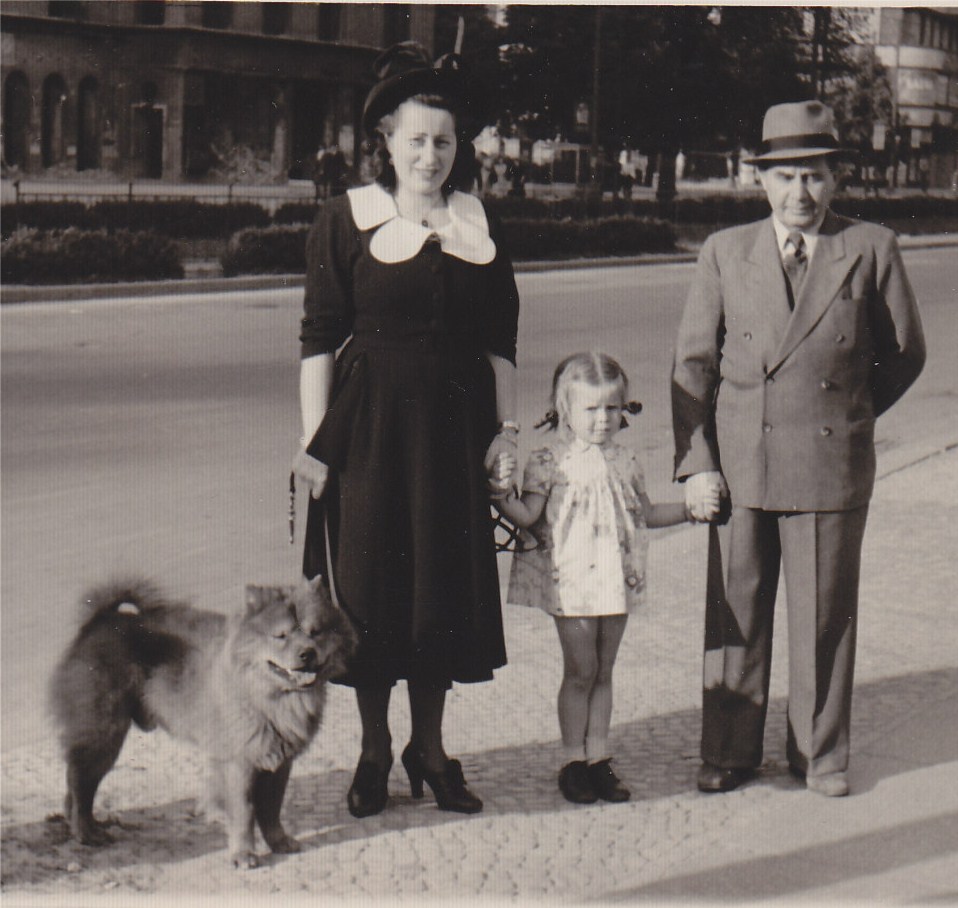
On the wall in my writing area is a small black and white photo of two adults dressed in 1940’s era clothes.  The woman wears a dark dress with a large white scalloped collar.  Her head is crowned with a rakish hat.  He wears a double-breasted suit and a fedora.  She smiles proudly.  His serious expression seems about to break into a smile.

Between them, clutching her grandparents’ hands, stands a little girl of about three in a pigtails, squinting at the sun.  To their side standing guard is a chow dog.  His name is Teddy.  Gifted as he was with  a dog’s keen sense of its surroundings, a few years later Teddy will be the one to notify the family,  with a nudge and a whimper, that the grandfather, lying in his sickbed, has died.

The little group is standing on the sidewalk of what is a broad European boulevard, once flanked by elegant houses and shops and busy with pedestrians.  But now this boulevard is virtually barren of other people or vehicles, or anything at all except paving and the unadorned fronts of buildings that stare at the camera with dark, empty spaces where there had been windows.

This is Kurfurstendamm,  Berlin’s Fifth Avenue, in 1947.  When World War II ended for Germany in May of 1945, 75-85% of the city had been destroyed by Allied carpet bombing.   Roughly 40,000 tons of shells fell on Berlin in the last 14 days before surrender on May 7, 1945, a bombardment of civilian targets that gives ‘gratuitous’ a whole new meaning.  Few living then or now would accept that the devastation, German civilian deaths (estimated at 2.5 million, primarily from “collateral fatalities” and the famine of 1945-46) were sufficient penance for the horrors inflicted upon many more millions by the Nazis and their morally obtuse followers.   Some tragedies are beyond the scope of “healing”  or “closure,” the brass coins we toss into the murky waters of our human cruelties.

The grandfather in the photo could remember an earlier time in Berlin at the threshold of World War I.  “Berlin,” wrote Barbara Tuchman in The Proud Tower (1962) was “the natural enemy of Munich and Bavaria.”  Germans from the south thought Berliners cynical and depraved.   The city was either loved or despised as the New York City of central Europe, and for comparable reasons: It was a center of intellectual and cultural life, much of it nourished by Jewish scholars and artists, a crossroads of cultures, and leftist politics.

During the 1920s, before Hitler’s ascent to power, Berlin was the center of a renaissance described by Otto Friedrich in  Before the Deluge (1972). Some of the century’s most gifted figures in the arts and intellectual life–men and women like Sol Hurok, Artur Schnabel, Rudolf Serkin, Yehudi Menuhin and the Zionist and civil rights leader Rabbi Joachim Prinz, who were driven out by the Nazis—remembered the city with affection and sadness.

To see some of the grandfather’s pre-World War I Berlin,  today’s visitor can wander into the Maerkisches  Museum.  This neo-Gothic red brick structure stands beside a quiet garden on the banks of the Spree River.  It resembles a church,  with its huge square red-brick tower startling passersby when it first appears between the trees.   Once inside one might hear the bell, accompanied by the deep rumbling sound of wooden wheels rolling over stone, that announces another step in the gradual rotation of a large circular stereopticon.  Its elaborately carved red mahogany cabinetry nearly fills the room.  At each of the  several individual viewing positions spaced evenly around its sides  a visitor can sit and peer  at 25 successive  ‘3-D’ photographs of the urban bustle and ceremonial traffic of Berlin during its own ‘gilded age’ at the end of the 19th century.  In one image a young man in a homburg hat appears to have stepped suddenly into the foreground as if to speak to the viewer.

Also astonishing in its immediacy is the face of a life-sized wooden figure of the Virgin Mary standing in the museum’s great hall.  She is surrounded by the mute company of other wooden medieval figures.  Her face is unlike most of the other faces one sees on the countless medieval sculptures populating western Europe’s historic places, for this young woman beams an affectionate, this-worldly radiance.  With her relaxed posture, she seems an icon  released into life.  There she stands, balanced at the far edge of medieval Catholicism,  welcoming the coming of Christian humanism and the northern Renaissance.

It in no way disparages the Maerkisches Museum to observe that its medieval religious carvings and delightful stereopticon, capturing for posterity the busy Potsdamer Platz of the first capital of the German Empire (1871-1918), intimate the intellectual prelude to the Third Reich.  They are like a theater’s scrim.  Absent illumination they conceal the ideas which, given the right historical moment, would play out as among the millenium’s greatest tragedies.

For all the intellectual emancipation from early Christian dogma and Papal authority that Europe experienced during the 16th and 17th centuries, and for all the liberalization of intellectual life during the Enlightenment, European Jews were not relieved of their stigma as enemies of Christianity. Driven out of England, France and Germany in the 14th and 15th centuries,  eventual emancipation came to them in much of Europe only in the decades after the French revolution.  Not until after German unification in 1871 did emancipation finally came to Germany’s Jews.  The decades of cultural and economic assimilation that followed came to naught, however.  Germany’s defeat in World War I and fear of Bolshevism after the Russian Revolution provided new pretexts for  a revival of virulent anti-semitism.

Compounding cultural stereotypes that became so perilous for Germany’s Jews was the doctrine of the mystical “state,” a political doctrine that the young man staring back at us at the Maerkisches Museum would have learned at the University of Berlin.  There, students (including American students for whom a German doctorate was de rigueur) learned from the heirs of G.W.F. Hegel that humans are destined by history to strive toward an ideal unity embodied in political form.  There could be no individual identity outside of a historically transcendent cultural, ethnic and political nationality.  The step from this mystical and all encompassing view of human destiny to Aryan exceptionalism and imperialism was short indeed.

But as American pragmatism taught, ideas have consequences, and can be known by them.  The horrendous consequences of Germany’s intoxication with the notion of its Aryan destiny are memorialized in Berlin in an array of  2,700 unmarked concrete plinths of various sizes, set in orderly rows on undulating pavement.  Beneath the assemblage of slabs, which covers the area of a small city block near the Brandenburg Gate, is a small museum with exhibits illustrating the Holocaust.

Although the absence of markings  on the slabs  is deliberate, lest the memorial appear to be a cemetery, some—walking thoughtfully through it—might recall the old Jewish cemetery in Prague.  And others,  very young and less wise and affected, have found it a perfect place to play hide and seek.  Berlin is full of ironies, and this is certainly one:  Survival for millions of European Jews was in fact a most deadly game of hide and seek.

Communities finding themselves alien in a world in which they are “not like us” can be torn, as they struggle for survival, between assimilation and separateness.  It is this which the concrete slabs of Berlin’s Holocaust Memorial, opened in 2005 after much controversy, seem to represent most of all.  Architecturally it is utterly out of place among the more conventionally modern or rebuilt Wilhelmine structures that surround it.   At the same time the rows of similar (though not identical) slabs are nameless, faceless, characterless.

Also architecturally out of place is Berlin’s Jewish Museum, but its dramatic design is far more eloquent.  The building tells its own tale of discontinuities in its dramatic zig-zag outlines—a feature that is retained in the shapes of its windows and  interior spaces.   Its underground corridors, sudden voids,  irregularly shaped rooms,  and Garden of Exile with tilted stelae blanketed in vines and olive trees are the perfect architectural setting for the story the building tells.  In its exhibits visitors can see and contemplate the shards of the history of a remarkable people, a story of life and loss, again and again.  Daniel Libeskind’s extraordinary building shares nothing with the Maerkisches Museum—except its foundations.

(Please continue to Berlin, Then and Now:  Part II)

Post to Twitter Tweet This Post

Berlin, Then and Now: Part II

The tourist buses that unload passengers at the Pergamon Museum and Check Point Charlie rarely stop at the Maerkisches Ufer (quay) of the Spree Canal.  Here reign peace and quiet accompanied by the gentle slip slap of water on the sides of old river barges.  Showing their age, a few barges have been turned by enterprising owners into  small ‘museums.’  Along the ufer a pair of restored neo-classical urban villas bears further witness to the bustling prosperity captured in the stereoscopic images at the Maerkisches Museum.

If one has only one day of beautiful weather to spend in this city, spend it on one of the low-slung passenger boats that chug along  the city’s canals and  encircling Spree and Havel rivers.  For six centuries these waterways, spanned today by hundreds of bridges, were Berlin’s  veins and arteries.  There may be no finer way to glimpse the vagaries of Berlin’s history since its beginnings in the  13th century as a trading center on the north bank of the Spree River.

A boat cruise around the city offers a slowly moving window onto its many neighborhoods–residential, governmental, commercial, rich and poor.  Here, the overflowing trees, shrubs, and flowers of a neglected garden at the back of a villa.  There, the dreary walls of a factory and workers’ housing.   But suddenly, as your boat chugs past the Mendelssohn-Bartholdy park and passes under the Schoeneberger bridge, there in front of you suspended in mid-air from a crane over the German Museum of Technology, is a Douglas C-47 military cargo plane (DC-3 in civilian usage).  The twin-engine aircraft initiated the flights—one every three minutes—of the British and American life line to Berlin after the Soviet Union,  whose post-war zone of occupation included the city, closed off land access on June 24, 1948.

Almost overnight the western allies’ strategic objective of utterly destroying Germany was turned on its head.  Resisting that other horrific would-be hegemon of the mid-twentieth century, the Soviet Union (1922-1991) under Stalin, upturned U.S. military and diplomatic planning.   Berlin would become a beacon of freedom in the long gray twilight that settled over Eurasia during the Cold War.

Where only a few years before aircraft overhead released a fiery apocalypse, now western allied aircraft alone would supply the food, coal and kerosene the city’s people needed merely to stay alive.   This time  modern technology played the essential role in sustaining life,  instead of raining death and destruction.  It cannot be said of all things, “this too, shall pass.”  But it could have been said of the Gӧtterdӓmmerung that occurred over Berlin at the end of World War II.

Berliners called them “rosinenbombers,” or raisin bombers.   Along with Great Britain’s RAF Handley Page Hastings transport aircraft, the US Air Force’s Douglas C-54 (successor to the C-47) ferried well over 5,000 tons  daily of food and fuel into Berlin from June 24, 1948 until September, 1949.  (Though the Soviets abandoned their unsuccessful blockade in May, the western allies continued to build up supplies in the beleaguered city.)  In all kinds of weather heavily loaded cargo planes flew back and forth through three 20-mile wide air corridors between British and American bases in their respective zones of occupation and two hastily repaired air fields in western Allied-occupied sectors of Berlin.

Romance confers the greatest heroism on the pilots and their aircraft.  But the truly miraculous was achieved by the mostly anonymous magicians of logistics. The organization and improvised equipment necessary to load, take-off, pilot, land, unload, and service over 275,000 flights at the rate of one every three minutes was unprecedented. Wal-Mart, FedEx and United Parcel today would be unable to function without the electronic data exchange systems developed during the Berlin airlift to ensure that every bundle of coal and package of dry milk, flour, sugar, pasta, coffee, chocolates and (of course) raisins was collected, inventoried, assigned, loaded, dispatched, flown, unloaded, warehoused and delivered as intended.

On an autumn day one can walk down Clayallee, once the busy central thoroughfare of the American sector in Berlin, virtually alone.  The avenue is named for General Lucius D. Clay, military governor of the American sector of Berlin and, with President Harry S. Truman, responsible for what was a perilous challenge to the Soviet Union in the early hours of the Cold War.  Only an occasional bicycle, tradesman’s van, or private car disturbs the quiet of what is now an affluent residential neighborhood.

Walking from the nearest U-bahn station to the former Outpost theater where GI’s gathered—and which is now the Allied Museum—one might almost miss the somewhat overgrown marble block engraved with Truman’s name, indicating an abandoned park and playing field.  A few steps further the calm of this place is interrupted by the sight of four horses, frozen in bronze, leaping over chunks of a broken wall.  This monument to the collapse of the Berlin Wall in 1989 marks the second time for this city that the political acumen of a few, and the patient persistence of millions, overcame on an historic scale the powerful forces of a malign autocracy.

At the entrance to the Allied Museum stands one of the RAF’s Hastings aircraft.  Compared with today’s regional aircraft, it seems small, though its burden multiplied thousands of times was huge.  The museum itself is dimly lit and lovingly tended.  Hordes of tourists throng the “Checkpoint Charlie” guard house on Friedrichstrasse to have their photos taken with latter day ‘guards’ and buy tchotchkes in the shops that flank that historic street.  But to see the weather-worn original guard house one must find the Allied Museum.  Photographs, old letters and diaries, newsreels, recordings, historical timelines–all attempt to retain, for a moment, an ever receding vanishing point in our historical mindscape.

Thanks to the timeless and universal language of music, one needs no memory at all to treasure still one of the glories of Berlin, the Berlin Philharmonic, founded in 1882.  Nearly bankrupt in 1933, the orchestra managed to survive under Wilhelm Furtwängler only by performing music—Beethoven, Bruckner, and Wagner, among others—that Hitler considered emblematic of German genius and power.

Today the Berlin Philharmonic appears on every list of the world’s top orchestras.  It also performs in a building—the term seems inadequate for the extraordinary architectural composition of spatial sections that is its home concert hall—whose pentagonal interior offers excellent acoustics for virtually every seat in the house.  The 1956 Hans Sharoun design manifests another benign aspect of Germany’s recent history:  The outward appearance of the “Berlin Phil’s” own performance space has been liberated from any compulsion to perpetuate the grand architectural style of Wilhelmine Germany.

Also liberated is the orchestra’s programming.  A recent performance paired Alban Berg’s  only violin concerto with Shostakovich’s 8th symphony. Conducted by guest conductor Andris Nelsons, a Latvian, with his countrywoman Baiba Skride playing the Berg on the Stradivarius “Wilhelmj” violin, the performances earned conductor and soloist a long roar of clapping and shouts of praise that lasted until the performers had long gone and the stage lights had been extinguished. But that is what we have now come to expect, once again, from the Berlin Philharmonic.

When she was eleven the little girl from the photograph  made the first  of several return trips to Berlin from the United States, where she  was taken in the early weeks of the airlift.  Piles of rubble still lay here and there interspersed with dreary, hastily built, apartment blocks with shops on their first floors.  Streets were still fairly empty of private cars, as taxis, buses, and bicycles did the job of moving Berliners about.

Coming from a country where bicycles were then used mostly by children, she might have been forgiven during her visit for walking down a specially constructed and marked bicycle lane.  But a policeman strode up to her and, in a harsh voice, berated her for obstructing the bicycle lane.  From the high peak of his German officer’s service hat to the stiffness of his posture and the black shine of his boots, here was a terrifying reminder of an officially vanquished past.

Today Berlin’s streets are as busy as any other European capital’s, but Berliners still make good use of their wonderful bus, streetcar, and subway system.  On concert nights the city sends out extra buses to transport thousands of music lovers to their shrine, and to collect them afterwards to take them to wherever they might want to go.  Nor is the bus a poor man’s transportation.  Women and men in their best finery press themselves into the buses (queuing is not a German trait), and send up their own chorus of loudly voiced opinions about the concert.  Only the elegant Japanese ladies, dressed in traditional coiffure, kimonos, obis and geta, huddle together on the sidewalk as long black Mercedes limousines arrive to collect them.

Of course, after the concert one wants to be sure to wait at the right bus stop.  That same autumn day, before she goes into the hall to hear Berg and Shostakovich, another policeman approaches the little girl—only she is now over a half–century older.  This time he seems so young, wearing a loose fitting wind-breaker and ordinary brown leather street shoes.  A single side-arm is almost invisible at his hip. The stiffener is gone from his service hat.  Again, he speaks first:  “Excuse me, m’am; I forgot my watch.  Could you please tell me the time?”  Age emboldens many of us.  “Well,” she replies, “I’ll tell you the time, if you tell me where the 110 bus to Kurfurstendamm stops.”  He tells her; and she tell him that it’s 7:30.  He thanks her pleasantly, and she continues on her way.

~~~


Post to Twitter Tweet This Post