Archive for the ‘Art and Culture’ Category

Why The Liberal Arts?


It’s difficult to hear a discussion of education in the United States without being reminded of the urgency of increasing students’ proficiency in ‘STEM’ (science, technology, engineering and math) disciplines.  This, we learn, is necessary to secure their competitiveness in a technology-driven job market.  What is too rarely pointed out is that a primary purpose of technological innovation is to reduce labor costs, i.e., reduce jobs.  “New” technologies do not necessarily do an adequate job of replacing the jobs lost from obsolete industries.

We have been here before.  During the 1950s and 1960s, besting the Soviet Union in the “space race” required thousands of well-trained engineers.  That we had such individuals was a result not of STEM education campaigns, but GI-bill education benefits designed to soften the impact on unemployment by demobilized service men and women.

The National Defense Education Act of 1958 boosted college attendance from 15% to 40% in all disciplines, with results that are as interesting to social historians as to presidents of colleges and universities who have struggled to sustain the rapid campus expansions of the 1960s and 1970s.

Then, in the early 1980s, we were once again consumed by fears of national decline when faced with growing industrial powerhouses in formerly ‘foreign’ places, e.g., Japan—a fear well documented by David Halberstam’s The Reckoning (1986).  The Reagan administration, only a few months into its first term, appointed a National Commission on Excellence in Education which, in August of 1981, released “A Nation at Risk: The Imperative for Educational Reform.”

The report begins: “Our Nation is at risk. Our once unchallenged preeminence in commerce, industry, science, and technological innovation is being overtaken by competitors throughout the world.”  Less well remembered is the report’s emphasis on disciplines other than STEM, disciplines that lie at the heart of a liberal arts education:

“Our concern, however, goes well beyond matters such as industry and commerce. . . .  For our country to function, citizens must be able to reach some common understandings on complex issues, often on short notice and on the basis of conflicting or incomplete evidence. . . .  Indicators of the risk [include] . . . About 13 percent of all 17-year-olds in the United States can be considered functionally illiterate [while] nearly 40 percent cannot draw inferences from written material;  only one-fifth can write a persuasive essay.”

And now we have the results of a study, conducted by the American Association of Colleges and Universities and National Center for Higher Education Management Systems, released this week, of the education and occupation of 3 million US residents between the ages of 21 and 65.  Comparing the “earnings trajectories and career pathways” of majors in the liberal arts with those from STEM and professional or pre-professional fields, the study found that not only does a college degree matter, but that “at peak earnings ages (56-60)” liberal arts majors earn on average more than those who majored in the other fields.  What’s more, unemployment is lower among mature workers who were liberal arts majors.

This study, based on 2010-2011 census data, confirms what many of us have learned from experience: ordinary social skills and technical preparation may get a young adult through the gate, but they will not equip him or her to stay the course.  That is because a lifetime of work and living is full of change—personal and historical.  Success in living and working requires a well-furnished imagination; empathy for the many different ‘others’ with whom we will need to cooperate;  a grasp of the power of aesthetic pleasure of all kinds;  and a full command of at least one language enabling us to be articulate in a complete and accurate way.

These attributes come primarily from immersion in the liberal arts, a microcosm of a universe where syntax and a rich vocabulary matter not because of “correct form,” but because they build meaning, and meaning matters.  A few years out of a lifetime spent in the study of good writing, be it fiction or expository prose;  of social and political philosophies and systems;  of aesthetics made manifest in the arts; and, most of all, of the rich storehouse of human experience captured in our history, has been demonstrated, once again, to be time well spent.

###


Post to Twitter Tweet This Post

Lessons From Our Table

One of the blessings of the past holiday for this Maine parent was the return of adult children home for Christmas.  Humorists console some of us with tales of dysfunctional families to help dispel the mixed emotions conjured up by the holidays.  A largely functional family is also a blessing.

Ours has slogged its way through rough patches, and survived with humor and love intact, and more intelligence than when we started.   My three ’30-something’ children appear happy, have graduated from good universities, and are well on their way in their chosen professions—which might help to pay a few jaw-dropping student loans.

For their travels they were rewarded with a white Christmas (and New Year’s), not to mention the Portland Stage’s splendid performance of Dickens’ ‘A Christmas Carol.’  ‘Wow!’ said one of the three at the end, as he replaced the tissue furtively dug from a pocket to vanish the tear that no one noticed but his Mother.

The greatest pleasures were the conversations while dining with family and friends, and this year conversation often returned to those things that combine to form an education.   What transpires in Maine’s many varied K-12 schools will occasion a good bit of heat in 2013 (as it does every year) and, often more heat than light.  So, here is what attentive guests at our holiday meals might have taken away from our chatter:

‘Schooling’ is useful, but over-rated, whether one is schooling at home, or in a classroom.  Basic literacy and numeracy are essential, of course, but let us not fool ourselves into thinking that when the little ones traipse off to school—or we put away the breakfast dishes and haul out the ‘do it yourself’ teaching materials—that we are educating our children in the fullest sense of the term.

We learn less by instruction or persuasion, than by example.  Children regularly exposed to curiosity and wisdom in the adults who surround them will learn to recognize curiosity and wisdom not only in others, but as something to emulate in themselves.

With the possible exception of the ‘STEM’ subjects [science, technology, engineering and math], which by their nature require extensive systematic preparation to master, there are other vital qualities we invoke when we talk about education—qualities which, like the Christmas ghosts who escorted Mr. Scrooge on his painful journey—cannot be conjured up  from lesson plans.

“Critical thinking skills” and “creativity” —these important concepts have become the overused and under-examined bromides of our education debates, offered in contrast to the rigid accountability of standardized testing.  But neither critical thinking nor enduring creativity can emerge from vaporous language or vacuous minds.

The minds of children and the young need furnishing.  Woe to the child whose mind is furnished by the gargantuan marketing machine we call the ‘entertainment industry.’  The best furnishing comes through direct experience—broadened, deepened, and examined through reading.

It will be said that many children do not come from families where books and reading are a fact of daily life.   That may be so; but it is not insurmountable.  One of my children’s favorite memories is of Mrs. Zuidama, a warm and wise woman at their day-care center, who set aside an hour every day for story time.

Even earlier, as soon as the youngest could sit up in a stroller, we went several times a week to the children’s corner of the Bangor Public Library to paw through the shelves for our ‘take home’ books.  We rarely missed a weekly morning story time led by one of the librarians.

Read to children until they insist on reading for themselves.  What to read?  Ask your school or public librarian—who will appreciate the question.  Browse through the books yourself.   At our dinner table, the titles tumbled out, beginning with “Pat the Bunny” and “Goodnight, Moon.”  We have our favorites, but children are entitled to discover theirs.

E-readers and tablets?  They are no substitute for a child’s beloved jam-encrusted, page torn, spine frayed, and bed cover-buried book.  When the e-reader has run out of battery and we can’t find the dang charger, Charlotte will still be spinning her web.


Post to Twitter Tweet This Post

Senator Rubio’s Mistake

An astronomer writing in Slate recently takes Senator Marco Rubio (R-Fla.) to task for being unable (or unwilling?) to give the astronomers’ answer to a reporter’s question, posed during a press interview, about the age of the Earth.  After noting that the question has nothing to do with the proper subject of the interview, Rubio responds that the Earth’s age is a “mystery,” and that some believe the Biblical account of the Earth’s creation.

Not only is the hapless Senator a member of the Senate’s Commerce, Science and Technology Committee (and therefore he should have basic scientific facts on the tip of his tongue), but as a member of Congress he should know the age of the Earth because “all of our industry, all of our technology, everything that keeps our country functioning at all can be traced back to scientific research and a scientific understanding of the universe.”

Set aside the question of whether the astronomer has, on the tip of his tongue, the number identifying the next Congress (which will also be of great import to the nation, and the number is 113-1).  His argument is such a caricature of the rhetoric the science establishment trots out to appeal for funding increases that he does the cause of public support for scientific research a disservice.

Being able to remember a number (especially out of context) is hardly a sign of intelligence, character, wisdom or civic virtue, as Albert Einstein was not the first to remind us.  What’s more, beyond such accumulated physical facts as the contents of the periodic table or the boiling point of water, any scientific knowledge that cannot be replicated under laboratory conditions is dependent on the circumstances of its discovery.

Historians and philosophers of science, at least since Karl Popper, have convincingly demonstrated the contingency of most scientific “truths.”  Nor has the total reliance  of the economy and technological growth on scientific research been substantiated by decades of research in economic growth and business history.  Indeed, there have been instances when scientific research depended upon technological innovation, as in the cases of optics and computational machinery.  The relationship between science and technology is iterative, while much of technological innovation is due as much to economic “pull” as to scientific “push.”

While I am no fan of Sen. Rubio, the notion that science is the only form of “intelligence” worth our pursuit or admiration represents an appalling poverty of learning.   Those who believe that the Bible contains a literally true history of our world lack the gift of metaphor, and for that they are to be pitied more than ridiculed.

A starry sky on a clear winter Maine night is a wondrous thing to behold; so also is an infant’s first true smile.  If forced to choose, we should chose the smile.

Post to Twitter Tweet This Post

The Matthew Effect *

Whatever else the “Occupy” movement accomplishes, it has already popularized the fact–known for a decade to those who pay attention to such things–that the rich in the U.S. are getting richer, while the chasm between them and nearly everyone else is becoming wider, really wider.

The Concise Encyclopedia of Economics notes that “the most careful studies suggest that the top 10 percent of households, with average income of about $200,000, received 42 percent of allpretax money income in the late 1990s.  The top 1 percent of households, averaging $800,000 of income, received 15 percent of all pretax money income.”

Meanwhile, economic mobility–the ‘American dream’–has diminished compared to the promise of increased wealth awaiting our peers in Canada and many Western European countries.  Most jobs now being offered in the U.S. feature lower salaries and wages, fewer if any health benefits, and rarely pensions.

Every pundit has someone or something to blame, as if what this country is experiencing is contrary to nature, an alien blight on our divinely pre-ordained “city on a hill.”  Let the business cycle do its thing, those who have not yet lost their incomes hopefully urge us; let the free market do its thing, aspiring politicians from the right implore us; let research and innovation restore us to prosperity for all, many on the left advise.  But, alas, we are in this pickle precisely because the business cycle, the free market, and technological innovation have been doing their thing.  Whether their destructive consequences are ‘creative’ for the long term, or in a fashion we can accept, remains to be seen.

From the get-go the purpose of technological innovation has been to reduce the cost of production, of which labor is among the largest and least tractable, with or without factories and unions.  Yearly cornucopias of new products to incite consumer spending are at bottom a promise of less work and more play.  Technological innovation today is splendid for innovators, and for entrepreneurs, and for patent attorneys, and for those who package IPO’s.  But it does not create jobs for the multitudes because the technology-driven industrial revolution is behind us.  Adam Smith, who wrote the script for American economic expansion (The Wealth of Nations, 1776), could not have foreseen our post-industrial economy.

Possibly the most powerful natural force leading to a growing chasm between the few rich and a shrinking middle class was recognized two millennia ago by the apostle Matthew, whose ‘day job’ was collecting taxes.  Matthew describes the disparate fortunes of those servants of the Lord who multiply their talents and those who do not: “For unto every one that hath shall be given, and he shall have abundance: but from him that hath not shall be taken away even that which he hath.”[Matthew 28:29]

Two millennia later the sociologist Robert Merton would attribute professional recognition among Nobel laureates to the “Matthew Effect,” a psycho-sociological process having less to do with scientific merit, and more to do with a natural human attraction to success and abhorrence of failure.  The world of sports, where the playing field should be the final arbiter of merit at any given moment, has evolved “winner take all” victories, as if that makes the contest more rewarding to spectators.  And it probably does.

Like the miracle of compound interest, cumulative achievement multiplies the possibilities for greater success.  The rewards for winning early can be enormous over a lifetime, while the human and social costs of early failures may never be overcome.  ‘Winner take all’ triumphs in business (e.g. Microsoft, Google), the advantage of incumbency in our politics and the workings of the US electoral college system, and the cumulative gains from an educational ‘head start’–life is rich with examples of the “Matthew effect” at work.

Whether or not it is a good thing indefinitely for the few to reap rewards vastly out of proportion to their merit and due, while increasing numbers struggle to survive, depends on who is defining the ‘good.’  Sooner or later, however, we will arrive at a tipping point when–as in 1789, 1848 and 1917–defining the ‘good’ will have become an academic exercise.

* (This article first appeared in the Portland Press Herald for January 18, 2012)

Post to Twitter Tweet This Post

Berlin: Then and Now, Part I

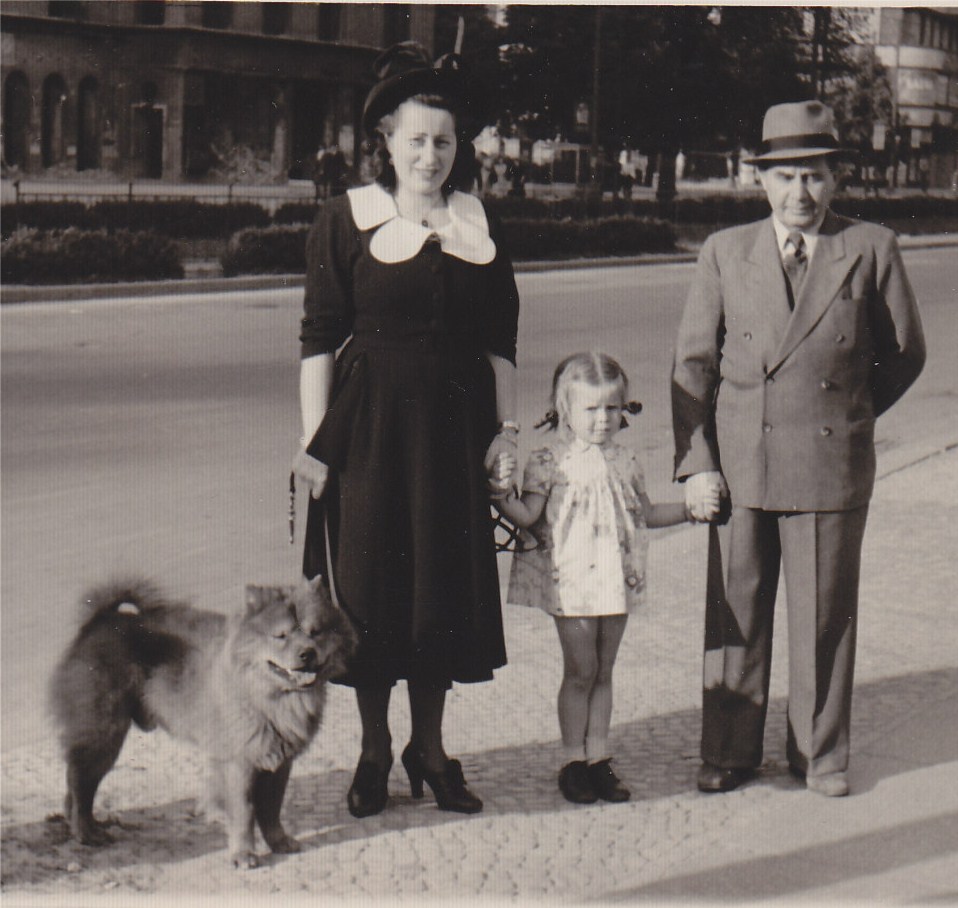
On the wall in my writing area is a small black and white photo of two adults dressed in 1940’s era clothes.  The woman wears a dark dress with a large white scalloped collar.  Her head is crowned with a rakish hat.  He wears a double-breasted suit and a fedora.  She smiles proudly.  His serious expression seems about to break into a smile.

Between them, clutching her grandparents’ hands, stands a little girl of about three in a pigtails, squinting at the sun.  To their side standing guard is a chow dog.  His name is Teddy.  Gifted as he was with  a dog’s keen sense of its surroundings, a few years later Teddy will be the one to notify the family,  with a nudge and a whimper, that the grandfather, lying in his sickbed, has died.

The little group is standing on the sidewalk of what is a broad European boulevard, once flanked by elegant houses and shops and busy with pedestrians.  But now this boulevard is virtually barren of other people or vehicles, or anything at all except paving and the unadorned fronts of buildings that stare at the camera with dark, empty spaces where there had been windows.

This is Kurfurstendamm,  Berlin’s Fifth Avenue, in 1947.  When World War II ended for Germany in May of 1945, 75-85% of the city had been destroyed by Allied carpet bombing.   Roughly 40,000 tons of shells fell on Berlin in the last 14 days before surrender on May 7, 1945, a bombardment of civilian targets that gives ‘gratuitous’ a whole new meaning.  Few living then or now would accept that the devastation, German civilian deaths (estimated at 2.5 million, primarily from “collateral fatalities” and the famine of 1945-46) were sufficient penance for the horrors inflicted upon many more millions by the Nazis and their morally obtuse followers.   Some tragedies are beyond the scope of “healing”  or “closure,” the brass coins we toss into the murky waters of our human cruelties.

The grandfather in the photo could remember an earlier time in Berlin at the threshold of World War I.  “Berlin,” wrote Barbara Tuchman in The Proud Tower (1962) was “the natural enemy of Munich and Bavaria.”  Germans from the south thought Berliners cynical and depraved.   The city was either loved or despised as the New York City of central Europe, and for comparable reasons: It was a center of intellectual and cultural life, much of it nourished by Jewish scholars and artists, a crossroads of cultures, and leftist politics.

During the 1920s, before Hitler’s ascent to power, Berlin was the center of a renaissance described by Otto Friedrich in  Before the Deluge (1972). Some of the century’s most gifted figures in the arts and intellectual life–men and women like Sol Hurok, Artur Schnabel, Rudolf Serkin, Yehudi Menuhin and the Zionist and civil rights leader Rabbi Joachim Prinz, who were driven out by the Nazis—remembered the city with affection and sadness.

To see some of the grandfather’s pre-World War I Berlin,  today’s visitor can wander into the Maerkisches  Museum.  This neo-Gothic red brick structure stands beside a quiet garden on the banks of the Spree River.  It resembles a church,  with its huge square red-brick tower startling passersby when it first appears between the trees.   Once inside one might hear the bell, accompanied by the deep rumbling sound of wooden wheels rolling over stone, that announces another step in the gradual rotation of a large circular stereopticon.  Its elaborately carved red mahogany cabinetry nearly fills the room.  At each of the  several individual viewing positions spaced evenly around its sides  a visitor can sit and peer  at 25 successive  ‘3-D’ photographs of the urban bustle and ceremonial traffic of Berlin during its own ‘gilded age’ at the end of the 19th century.  In one image a young man in a homburg hat appears to have stepped suddenly into the foreground as if to speak to the viewer.

Also astonishing in its immediacy is the face of a life-sized wooden figure of the Virgin Mary standing in the museum’s great hall.  She is surrounded by the mute company of other wooden medieval figures.  Her face is unlike most of the other faces one sees on the countless medieval sculptures populating western Europe’s historic places, for this young woman beams an affectionate, this-worldly radiance.  With her relaxed posture, she seems an icon  released into life.  There she stands, balanced at the far edge of medieval Catholicism,  welcoming the coming of Christian humanism and the northern Renaissance.

It in no way disparages the Maerkisches Museum to observe that its medieval religious carvings and delightful stereopticon, capturing for posterity the busy Potsdamer Platz of the first capital of the German Empire (1871-1918), intimate the intellectual prelude to the Third Reich.  They are like a theater’s scrim.  Absent illumination they conceal the ideas which, given the right historical moment, would play out as among the millenium’s greatest tragedies.

For all the intellectual emancipation from early Christian dogma and Papal authority that Europe experienced during the 16th and 17th centuries, and for all the liberalization of intellectual life during the Enlightenment, European Jews were not relieved of their stigma as enemies of Christianity. Driven out of England, France and Germany in the 14th and 15th centuries,  eventual emancipation came to them in much of Europe only in the decades after the French revolution.  Not until after German unification in 1871 did emancipation finally came to Germany’s Jews.  The decades of cultural and economic assimilation that followed came to naught, however.  Germany’s defeat in World War I and fear of Bolshevism after the Russian Revolution provided new pretexts for  a revival of virulent anti-semitism.

Compounding cultural stereotypes that became so perilous for Germany’s Jews was the doctrine of the mystical “state,” a political doctrine that the young man staring back at us at the Maerkisches Museum would have learned at the University of Berlin.  There, students (including American students for whom a German doctorate was de rigueur) learned from the heirs of G.W.F. Hegel that humans are destined by history to strive toward an ideal unity embodied in political form.  There could be no individual identity outside of a historically transcendent cultural, ethnic and political nationality.  The step from this mystical and all encompassing view of human destiny to Aryan exceptionalism and imperialism was short indeed.

But as American pragmatism taught, ideas have consequences, and can be known by them.  The horrendous consequences of Germany’s intoxication with the notion of its Aryan destiny are memorialized in Berlin in an array of  2,700 unmarked concrete plinths of various sizes, set in orderly rows on undulating pavement.  Beneath the assemblage of slabs, which covers the area of a small city block near the Brandenburg Gate, is a small museum with exhibits illustrating the Holocaust.

Although the absence of markings  on the slabs  is deliberate, lest the memorial appear to be a cemetery, some—walking thoughtfully through it—might recall the old Jewish cemetery in Prague.  And others,  very young and less wise and affected, have found it a perfect place to play hide and seek.  Berlin is full of ironies, and this is certainly one:  Survival for millions of European Jews was in fact a most deadly game of hide and seek.

Communities finding themselves alien in a world in which they are “not like us” can be torn, as they struggle for survival, between assimilation and separateness.  It is this which the concrete slabs of Berlin’s Holocaust Memorial, opened in 2005 after much controversy, seem to represent most of all.  Architecturally it is utterly out of place among the more conventionally modern or rebuilt Wilhelmine structures that surround it.   At the same time the rows of similar (though not identical) slabs are nameless, faceless, characterless.

Also architecturally out of place is Berlin’s Jewish Museum, but its dramatic design is far more eloquent.  The building tells its own tale of discontinuities in its dramatic zig-zag outlines—a feature that is retained in the shapes of its windows and  interior spaces.   Its underground corridors, sudden voids,  irregularly shaped rooms,  and Garden of Exile with tilted stelae blanketed in vines and olive trees are the perfect architectural setting for the story the building tells.  In its exhibits visitors can see and contemplate the shards of the history of a remarkable people, a story of life and loss, again and again.  Daniel Libeskind’s extraordinary building shares nothing with the Maerkisches Museum—except its foundations.

(Please continue to Berlin, Then and Now:  Part II)

Post to Twitter Tweet This Post

Berlin, Then and Now: Part II

The tourist buses that unload passengers at the Pergamon Museum and Check Point Charlie rarely stop at the Maerkisches Ufer (quay) of the Spree Canal.  Here reign peace and quiet accompanied by the gentle slip slap of water on the sides of old river barges.  Showing their age, a few barges have been turned by enterprising owners into  small ‘museums.’  Along the ufer a pair of restored neo-classical urban villas bears further witness to the bustling prosperity captured in the stereoscopic images at the Maerkisches Museum.

If one has only one day of beautiful weather to spend in this city, spend it on one of the low-slung passenger boats that chug along  the city’s canals and  encircling Spree and Havel rivers.  For six centuries these waterways, spanned today by hundreds of bridges, were Berlin’s  veins and arteries.  There may be no finer way to glimpse the vagaries of Berlin’s history since its beginnings in the  13th century as a trading center on the north bank of the Spree River.

A boat cruise around the city offers a slowly moving window onto its many neighborhoods–residential, governmental, commercial, rich and poor.  Here, the overflowing trees, shrubs, and flowers of a neglected garden at the back of a villa.  There, the dreary walls of a factory and workers’ housing.   But suddenly, as your boat chugs past the Mendelssohn-Bartholdy park and passes under the Schoeneberger bridge, there in front of you suspended in mid-air from a crane over the German Museum of Technology, is a Douglas C-47 military cargo plane (DC-3 in civilian usage).  The twin-engine aircraft initiated the flights—one every three minutes—of the British and American life line to Berlin after the Soviet Union,  whose post-war zone of occupation included the city, closed off land access on June 24, 1948.

Almost overnight the western allies’ strategic objective of utterly destroying Germany was turned on its head.  Resisting that other horrific would-be hegemon of the mid-twentieth century, the Soviet Union (1922-1991) under Stalin, upturned U.S. military and diplomatic planning.   Berlin would become a beacon of freedom in the long gray twilight that settled over Eurasia during the Cold War.

Where only a few years before aircraft overhead released a fiery apocalypse, now western allied aircraft alone would supply the food, coal and kerosene the city’s people needed merely to stay alive.   This time  modern technology played the essential role in sustaining life,  instead of raining death and destruction.  It cannot be said of all things, “this too, shall pass.”  But it could have been said of the Gӧtterdӓmmerung that occurred over Berlin at the end of World War II.

Berliners called them “rosinenbombers,” or raisin bombers.   Along with Great Britain’s RAF Handley Page Hastings transport aircraft, the US Air Force’s Douglas C-54 (successor to the C-47) ferried well over 5,000 tons  daily of food and fuel into Berlin from June 24, 1948 until September, 1949.  (Though the Soviets abandoned their unsuccessful blockade in May, the western allies continued to build up supplies in the beleaguered city.)  In all kinds of weather heavily loaded cargo planes flew back and forth through three 20-mile wide air corridors between British and American bases in their respective zones of occupation and two hastily repaired air fields in western Allied-occupied sectors of Berlin.

Romance confers the greatest heroism on the pilots and their aircraft.  But the truly miraculous was achieved by the mostly anonymous magicians of logistics. The organization and improvised equipment necessary to load, take-off, pilot, land, unload, and service over 275,000 flights at the rate of one every three minutes was unprecedented. Wal-Mart, FedEx and United Parcel today would be unable to function without the electronic data exchange systems developed during the Berlin airlift to ensure that every bundle of coal and package of dry milk, flour, sugar, pasta, coffee, chocolates and (of course) raisins was collected, inventoried, assigned, loaded, dispatched, flown, unloaded, warehoused and delivered as intended.

On an autumn day one can walk down Clayallee, once the busy central thoroughfare of the American sector in Berlin, virtually alone.  The avenue is named for General Lucius D. Clay, military governor of the American sector of Berlin and, with President Harry S. Truman, responsible for what was a perilous challenge to the Soviet Union in the early hours of the Cold War.  Only an occasional bicycle, tradesman’s van, or private car disturbs the quiet of what is now an affluent residential neighborhood.

Walking from the nearest U-bahn station to the former Outpost theater where GI’s gathered—and which is now the Allied Museum—one might almost miss the somewhat overgrown marble block engraved with Truman’s name, indicating an abandoned park and playing field.  A few steps further the calm of this place is interrupted by the sight of four horses, frozen in bronze, leaping over chunks of a broken wall.  This monument to the collapse of the Berlin Wall in 1989 marks the second time for this city that the political acumen of a few, and the patient persistence of millions, overcame on an historic scale the powerful forces of a malign autocracy.

At the entrance to the Allied Museum stands one of the RAF’s Hastings aircraft.  Compared with today’s regional aircraft, it seems small, though its burden multiplied thousands of times was huge.  The museum itself is dimly lit and lovingly tended.  Hordes of tourists throng the “Checkpoint Charlie” guard house on Friedrichstrasse to have their photos taken with latter day ‘guards’ and buy tchotchkes in the shops that flank that historic street.  But to see the weather-worn original guard house one must find the Allied Museum.  Photographs, old letters and diaries, newsreels, recordings, historical timelines–all attempt to retain, for a moment, an ever receding vanishing point in our historical mindscape.

Thanks to the timeless and universal language of music, one needs no memory at all to treasure still one of the glories of Berlin, the Berlin Philharmonic, founded in 1882.  Nearly bankrupt in 1933, the orchestra managed to survive under Wilhelm Furtwängler only by performing music—Beethoven, Bruckner, and Wagner, among others—that Hitler considered emblematic of German genius and power.

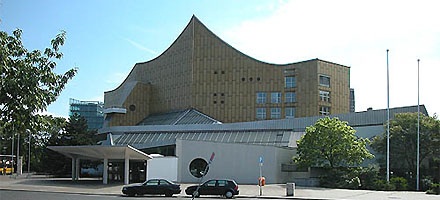
Today the Berlin Philharmonic appears on every list of the world’s top orchestras.  It also performs in a building—the term seems inadequate for the extraordinary architectural composition of spatial sections that is its home concert hall—whose pentagonal interior offers excellent acoustics for virtually every seat in the house.  The 1956 Hans Sharoun design manifests another benign aspect of Germany’s recent history:  The outward appearance of the “Berlin Phil’s” own performance space has been liberated from any compulsion to perpetuate the grand architectural style of Wilhelmine Germany.

Also liberated is the orchestra’s programming.  A recent performance paired Alban Berg’s  only violin concerto with Shostakovich’s 8th symphony. Conducted by guest conductor Andris Nelsons, a Latvian, with his countrywoman Baiba Skride playing the Berg on the Stradivarius “Wilhelmj” violin, the performances earned conductor and soloist a long roar of clapping and shouts of praise that lasted until the performers had long gone and the stage lights had been extinguished. But that is what we have now come to expect, once again, from the Berlin Philharmonic.

When she was eleven the little girl from the photograph  made the first  of several return trips to Berlin from the United States, where she  was taken in the early weeks of the airlift.  Piles of rubble still lay here and there interspersed with dreary, hastily built, apartment blocks with shops on their first floors.  Streets were still fairly empty of private cars, as taxis, buses, and bicycles did the job of moving Berliners about.

Coming from a country where bicycles were then used mostly by children, she might have been forgiven during her visit for walking down a specially constructed and marked bicycle lane.  But a policeman strode up to her and, in a harsh voice, berated her for obstructing the bicycle lane.  From the high peak of his German officer’s service hat to the stiffness of his posture and the black shine of his boots, here was a terrifying reminder of an officially vanquished past.

Today Berlin’s streets are as busy as any other European capital’s, but Berliners still make good use of their wonderful bus, streetcar, and subway system.  On concert nights the city sends out extra buses to transport thousands of music lovers to their shrine, and to collect them afterwards to take them to wherever they might want to go.  Nor is the bus a poor man’s transportation.  Women and men in their best finery press themselves into the buses (queuing is not a German trait), and send up their own chorus of loudly voiced opinions about the concert.  Only the elegant Japanese ladies, dressed in traditional coiffure, kimonos, obis and geta, huddle together on the sidewalk as long black Mercedes limousines arrive to collect them.

Of course, after the concert one wants to be sure to wait at the right bus stop.  That same autumn day, before she goes into the hall to hear Berg and Shostakovich, another policeman approaches the little girl—only she is now over a half–century older.  This time he seems so young, wearing a loose fitting wind-breaker and ordinary brown leather street shoes.  A single side-arm is almost invisible at his hip. The stiffener is gone from his service hat.  Again, he speaks first:  “Excuse me, m’am; I forgot my watch.  Could you please tell me the time?”  Age emboldens many of us.  “Well,” she replies, “I’ll tell you the time, if you tell me where the 110 bus to Kurfurstendamm stops.”  He tells her; and she tell him that it’s 7:30.  He thanks her pleasantly, and she continues on her way.

~~~


Post to Twitter Tweet This Post